



At 4:58 PM, your front desk is wrapping up, your sales team is off the phones, and three new calls hit at once. One wants to book, one needs a status update, and one is ready to cancel if nobody answers. That is where the automated phone support vs call center decision stops being theoretical. It becomes an operations question with direct revenue impact.
For businesses that live on inbound calls, missed calls are missed appointments, missed leads, and unnecessary churn. But replacing people with software is not always the right move either. The real question is not which model sounds more advanced. It is which one handles your call volume, service expectations, and margin pressure better.
Automated phone support vs call center: the core difference
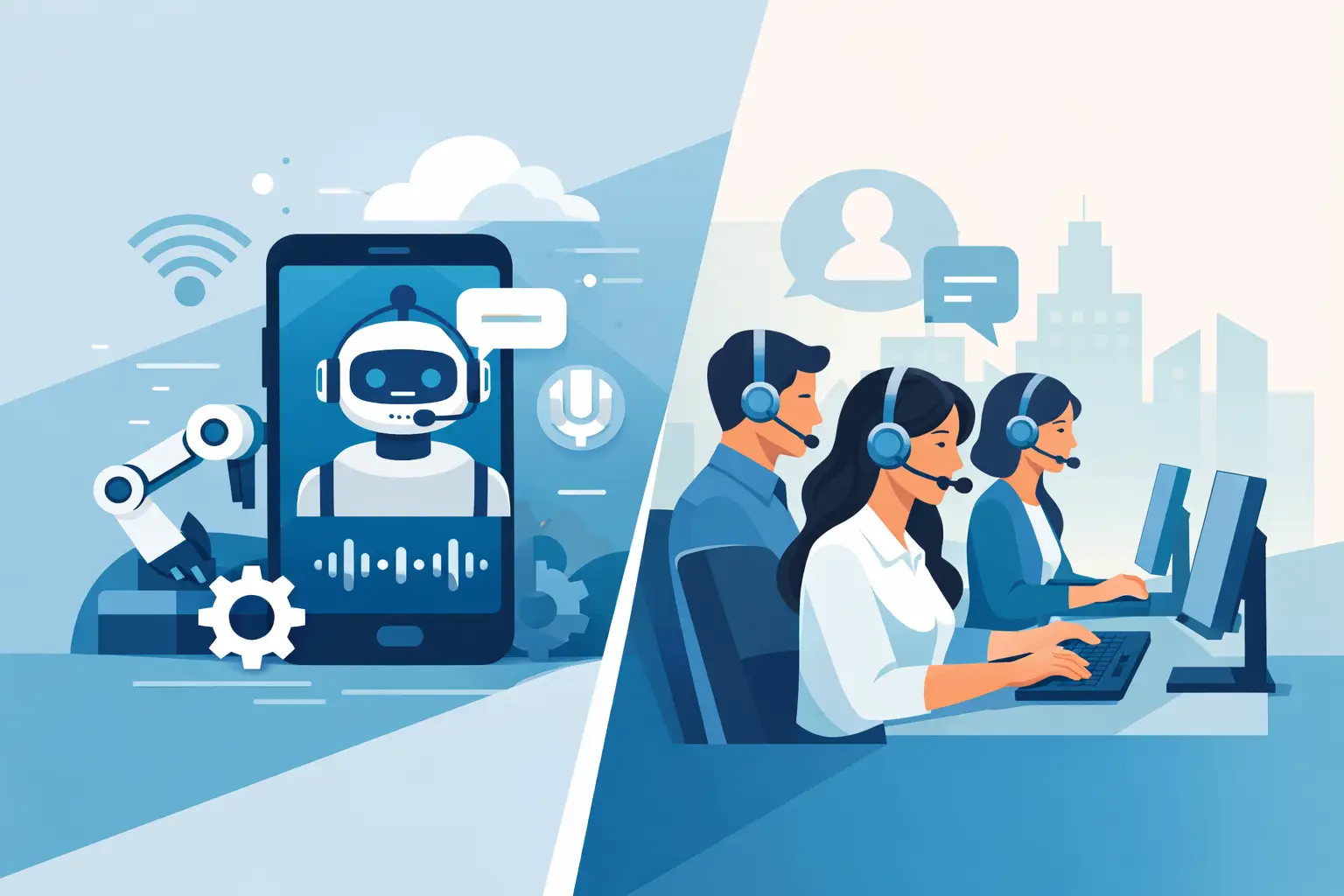
A traditional call center depends on human agents to answer, route, resolve, and document customer conversations. An automated phone support system uses AI voice agents, call flows, and integrated workflows to handle some or most of those interactions without a live rep on every call.
That difference changes the economics fast. A call center scales by hiring, training, scheduling, and supervising more agents. Automated support scales by handling more calls in parallel, following the same script every time, and pushing call data directly into your systems.
Neither model wins in every case. If your calls are highly emotional, legally sensitive, or require a lot of judgment, human agents still matter. If your business gets the same appointment, FAQ, intake, renewal, or lead qualification calls over and over, automation has a clear advantage.
Where automated phone support pulls ahead
The biggest advantage is availability. AI does not call out sick, ask for overtime, or leave your phones uncovered during lunch breaks. It can answer after hours, on weekends, and during spikes that would normally create hold times.
For a dental office, that might mean booking new patients after the front desk closes. For a dealership, it could mean catching service inquiries before a competitor does. For a law office, it might mean collecting intake details immediately instead of sending prospects to voicemail.
Speed matters just as much as coverage. Automated systems can answer instantly and handle multiple conversations at once. A traditional call center can deliver strong service, but only if staffing matches demand. When volume jumps unexpectedly, queues form. Customers wait. Some hang up.
Consistency is another major factor. Human agents vary. Some follow scripts closely. Some skip steps. Some log notes well. Some do not. Automated support delivers the same greeting, the same qualification logic, and the same routing path every time. That consistency is useful for booking, lead screening, payment reminders, appointment confirmations, and standard support requests.
Then there is the back-end impact. Good automated phone support does more than talk. It updates CRMs, triggers follow-ups, writes call summaries, and routes outcomes into calendars and operational tools. That cuts admin work and reduces the lag between conversation and action.
Where a call center still makes sense
Call centers are not going away, and they should not. There are still many situations where a skilled human agent is the better choice.
Complex issue resolution is one of them. If a customer has a billing dispute with multiple exceptions, a sensitive medical scheduling issue, or a complaint that needs empathy and negotiation, a live agent can read nuance better than most automated systems.
High-stakes sales can also favor humans. If the call involves objection handling, customized pricing, or relationship-building with enterprise buyers, a trained rep may close better than an automated flow. Automation can qualify and route those calls well, but not every deal should stay fully automated.
Brand perception matters too. Some customer bases expect a person, especially in premium service categories. If your business competes on white-glove support, fully replacing live agents may create friction.
The trade-off is cost and variability. Human-led support is flexible, but it is expensive to scale and harder to standardize. The more your call center grows, the more management overhead grows with it.
Cost is not just payroll
When companies compare automated phone support vs call center models, they often focus on wages first. That is only part of the math.
A call center includes recruiting, onboarding, training time, turnover, QA management, scheduling, absentee coverage, and software seats. Add nights, weekends, or multilingual support, and costs climb further. Even small teams become expensive once you factor in the full operating load.
Automated phone support shifts the cost structure. Instead of paying for idle time between calls, you pay for usage, platform access, and setup. That usually makes it more efficient for businesses with repetitive call patterns or fluctuating volume. You can handle overflow and off-hours demand without staffing for worst-case scenarios.
That said, automation is not free money. You still need to design call flows, define handoff rules, maintain your knowledge base, and monitor performance. If nobody owns the system, weak automation can frustrate callers just as much as a bad agent can.
The strongest ROI usually comes from replacing repetitive call work, not every call. If you remove the high-volume, low-complexity tasks first, your team can focus on the interactions that actually need human judgment.
Customer experience depends on the use case
People do not dislike automation. They dislike bad automation.
If a caller gets an immediate answer, clear options, accurate information, and a fast resolution, they usually care more about the result than whether the voice is human. This is especially true for routine needs like booking, confirmations, business hours, order status, lead qualification, and call routing.
Where automation breaks down is when it traps the caller. Long menu trees, poor speech recognition, irrelevant answers, and no path to a person create frustration fast. That is why the best automated systems are designed with a human handoff built in, not bolted on later.
A smart model is to automate the front half of the interaction and escalate when needed. Let AI answer instantly, gather context, verify intent, and complete straightforward tasks. If the request gets sensitive or complex, transfer the call with notes attached so the human agent starts with context instead of repeating questions.
That hybrid approach often outperforms both extremes. It reduces wait times without forcing every conversation into a rigid script.
Who should choose which model?
If you run a high-call-volume business with repeatable workflows, automated support is often the better first move. Healthcare practices, dental groups, salons, restaurants, real estate teams, dealerships, and legal intake operations all tend to have predictable call types that can be handled quickly and consistently.
If your operation needs after-hours coverage, multilingual support, or fast follow-up on inbound leads, automation becomes even more valuable. It lets you capture demand when your staff is unavailable and keeps response time close to zero.
A traditional call center makes more sense when your service model depends on complex conversations, emotional support, or consultative selling from the first touch. It can also be the right fit for businesses with lower call volume but higher-value interactions, where each conversation is unique.
For many teams, the answer is neither fully automated nor fully manual. It is staged automation. Start with appointment booking, FAQs, routing, reminders, renewals, and lead qualification. Keep live reps for escalations, exceptions, and revenue-critical conversations.
That is also the easiest path operationally. You do not need to redesign your whole customer experience overnight. You can deploy in phases, measure results, and expand only where the numbers justify it.
What to evaluate before you decide
Do not buy based on hype. Look at your call logs. How many calls are missed? How many are repetitive? How many happen after hours? How long does your team spend on basic scheduling, confirmations, and status checks?
Then look at outcomes. Are callers getting booked faster? Are leads being qualified consistently? Are call notes making it into your CRM? Are you paying skilled staff to do work that could be handled automatically in less time?
A strong automated platform should support natural voice conversations, reliable transfers, reporting, recordings, transcriptions, and direct integrations with the systems your team already uses. It should also let you control scripts, update knowledge easily, and see where calls succeed or fail.
If you are comparing vendors, ask a simple question: will this reduce operational drag in the next 30 days, or create another tool your team has to manage around?
Cloud One-Ai is built for that practical standard – automate the calls that slow your team down, connect them to your workflows, and keep a human available when the moment calls for it.
The best phone strategy is not the one with the most technology or the most headcount. It is the one that answers fast, converts reliably, and gives your team fewer repetitive calls to chase tomorrow.