



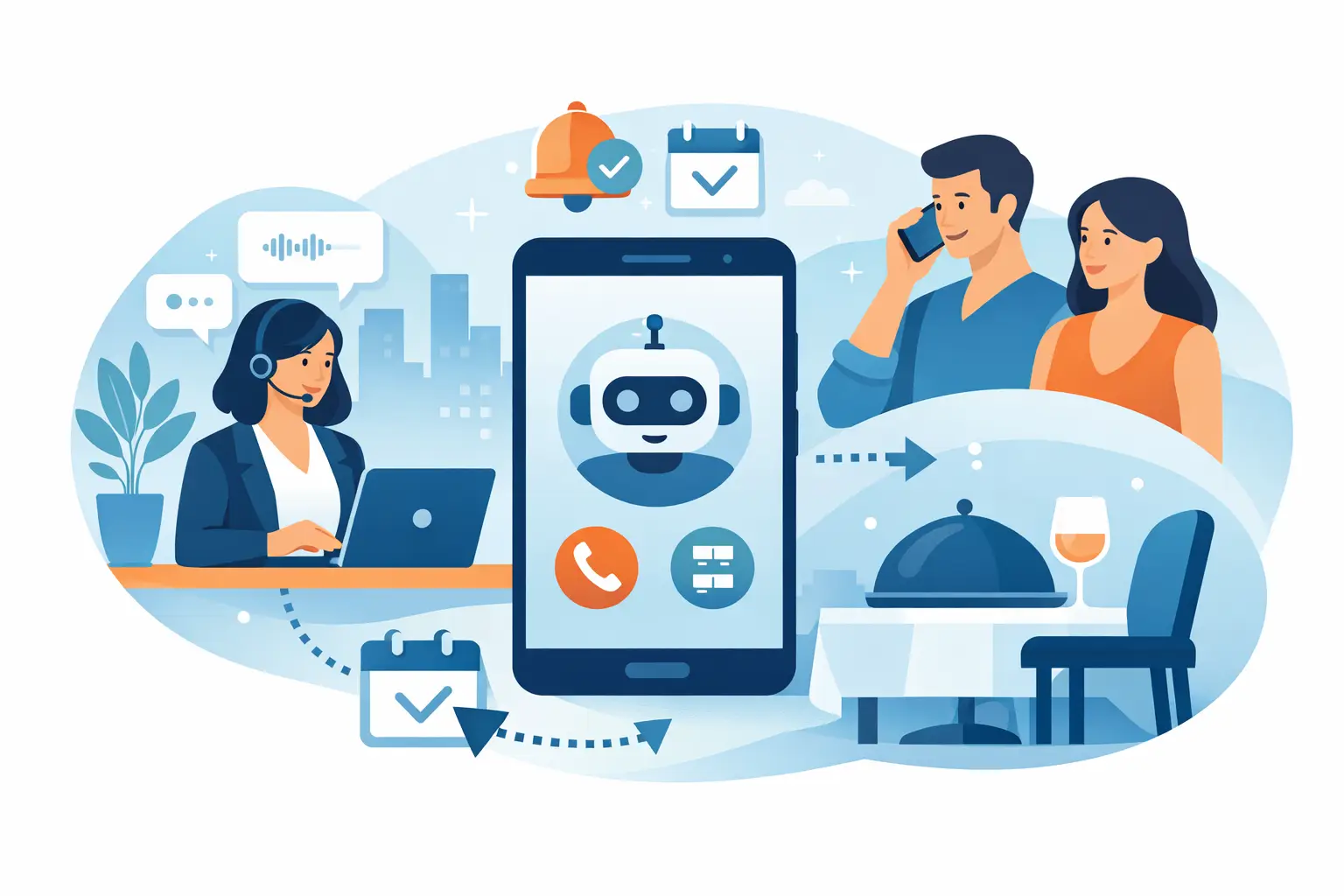
The phone rings while the host is seating a walk-in party, a server needs help at the bar, and the dinner rush is building. That missed call may be a two-top for tonight, a private dining inquiry, or a regular trying to change a reservation. Restaurant reservation call automation gives every caller an immediate answer without pulling the floor team away from the guests already in front of them.
For independent restaurants, busy neighborhood concepts, and multi-location operators, this is not about replacing hospitality with a recording. It is about protecting it. A well-configured AI voice agent handles the repeatable reservation work quickly, follows the restaurant’s rules, and transfers the exceptions that need a person.
Why reservation calls still create operational drag
Online booking has changed guest behavior, but it has not eliminated the phone. Callers still want to ask about a patio table, a large party, accessibility, dietary accommodations, corkage, parking, wait times, or whether a reservation can be moved by 30 minutes. During service, those calls arrive when the team has the least capacity to answer them well.
The cost is larger than a missed booking. A host who steps away repeatedly can slow the arrival experience. A rushed employee may enter the wrong party size or time. A caller placed on hold too long may book somewhere else. At multiple locations, inconsistent call handling also creates a brand problem: one restaurant sounds polished while another sounds unavailable.
Hiring enough people to cover every peak period is expensive, and staffing alone does not solve after-hours calls. Reservation demand often comes after work, during weekends, and when managers are not available to return voicemail. The operational goal is straightforward: answer immediately, capture accurate details, and keep the reservation system current.
What restaurant reservation call automation should do
A useful voice agent should sound natural, but natural conversation is only the starting point. The real value comes from connecting the call to the systems and policies that run the restaurant.
The agent answers with the correct location and greeting, asks for the date, time, party size, name, and callback number, then checks availability through the booking or calendar workflow. If a table is available, it confirms the reservation and sends the details where the team needs them. If the requested slot is unavailable, it can offer approved alternatives rather than ending the call with a dead end.
The same agent can manage common changes and cancellations. It can confirm the restaurant’s cancellation window, collect notes for celebrations or accessibility needs, and handle basic questions using an approved knowledge base. For a restaurant that accepts large-party requests, the agent can qualify the inquiry by gathering headcount, preferred date, contact details, and event needs before routing it to the events team.
This matters because speed and accuracy need to work together. A fast agent that invents availability creates bad guest experiences. An agent that only takes messages creates more follow-up work. The right setup operates within clear rules and uses live integrations or controlled workflows to prevent overbooking.
The calls that should go to a human
Automation should have boundaries. A caller who is upset, a guest with a complex accommodation request, a VIP complaint, or a private-event negotiation may need a manager or host immediately. The agent should recognize those triggers, explain that it is connecting the caller, and make a warm transfer when a team member is available.
Restaurants should also decide what the agent cannot promise. Do not let it guarantee a specific table, approve a special exception, quote a policy it cannot verify, or accept a large event without the required deposit process. Good automation protects the operation by staying inside the playbook.
Build the flow around your actual service rules
The strongest restaurant reservation call automation is not a generic script. It reflects how that location serves guests. Before deployment, document the decisions your host team makes every day: booking windows, maximum party sizes, turn-time assumptions, patio rules, holiday policies, late-arrival handling, and the point at which a request requires manager approval.
Start with the highest-volume call types. For many restaurants, that means new reservations, reservation modifications, cancellations, hours, directions, and waitlist questions. Handle those consistently first. Add private dining qualification, catering inquiries, lost-and-found requests, and feedback routing once the core flow is working.
Language coverage deserves attention as well. A restaurant serving a multilingual neighborhood should not force every caller into English or rely on staff to translate during a rush. Voice AI can support conversations in the languages and accents your guests use, while preserving the same operating rules across each call.
Keep the opening short. The caller wants a table, not a technology demonstration. A direct greeting such as, “Thanks for calling. I can help with reservations, changes, and restaurant information. What can I do for you?” sets the expectation and gets to the request quickly.
Connect calls to the reservation workflow, not a spreadsheet
The biggest failure point is treating calls as separate from operations. If the AI agent collects reservation details but someone must manually copy them into a booking platform later, delays and errors return. The agent should connect to the system of record, whether that is a reservation platform, calendar, CRM, point-of-sale workflow, or an internal operations tool.
For smaller restaurants, a calendar-based workflow may be enough to start. For a multi-location group, the requirements are typically more specific: location-aware routing, separate hours by venue, shared reporting, escalation rules, and clean handoffs to each store. The approach depends on the complexity of the operation, but the principle does not change. Every call outcome needs a defined destination.
Cloud One-Ai can connect calling workflows with more than 300 integrations, making it possible to route reservation data into the tools the team already uses. That is where voice automation becomes operational infrastructure instead of another inbox to manage.
Use reporting to improve the guest experience
Call recordings and transcriptions are not just management features. They show where the reservation process is creating friction. If callers repeatedly ask whether the patio is heated, add a clear answer to the agent’s knowledge base. If many guests request times the restaurant does not offer, refine alternative-time suggestions. If callers abandon while being transferred, review staffing coverage for that period.
Track a small set of outcomes that matter: answered-call rate, reservation conversion rate, abandoned calls, booked versus requested party size, transferred-call rate, cancellations, and repeat questions. Review them weekly during the first month. The goal is not to maximize automation for its own sake. It is to reduce missed revenue and make the guest journey easier.
Plan for busy nights, not quiet afternoons
A reservation flow can look perfect in a test call and still fail on a Saturday at 7:15 p.m. Test it under real conditions. Confirm that the agent understands common names, street pronunciations, nearby landmarks, and restaurant-specific terms. Make sure it handles noisy callers, interruptions, and people who change their mind mid-conversation.
Capacity matters too. A restaurant group may receive a surge of calls when weather changes, a local event ends, or a social post goes viral. An AI call center can handle multiple calls in parallel, so callers are not forced into a queue just because the host stand is busy. But the escalation path still needs coverage. If every complex call transfers to one unavailable manager, the experience breaks down.
Set up fallback behavior for uncertainty. When availability cannot be confirmed, the agent should take the caller’s details, state the next step honestly, and create a task for the right person. It should never pretend a reservation is confirmed when it is not.
A practical rollout for restaurant operators
Launch with one location or one defined call flow, then expand based on real call data. Start by loading accurate restaurant information: hours, address, menu guidance, reservation policies, accepted payment methods, parking notes, and special-event schedules. Give the agent only information you are comfortable having it share.
Next, connect the booking and notification workflows. Confirm what happens after a successful booking, a change, a cancellation, and a transfer. The restaurant should receive a clear record, and the guest should receive the confirmation method the operation supports.
Then listen to early calls. Adjust phrasing where callers hesitate. Tighten rules where the agent receives unclear requests. Add handoff triggers where the team needs more control. This is a service workflow, so the best version comes from real host-stand feedback, not assumptions made in a conference room.
A restaurant’s phone line is part of its front door. When every caller gets a fast, accurate, and helpful response, the host team can focus on the room, guests can book with confidence, and the next service starts with fewer loose ends.