



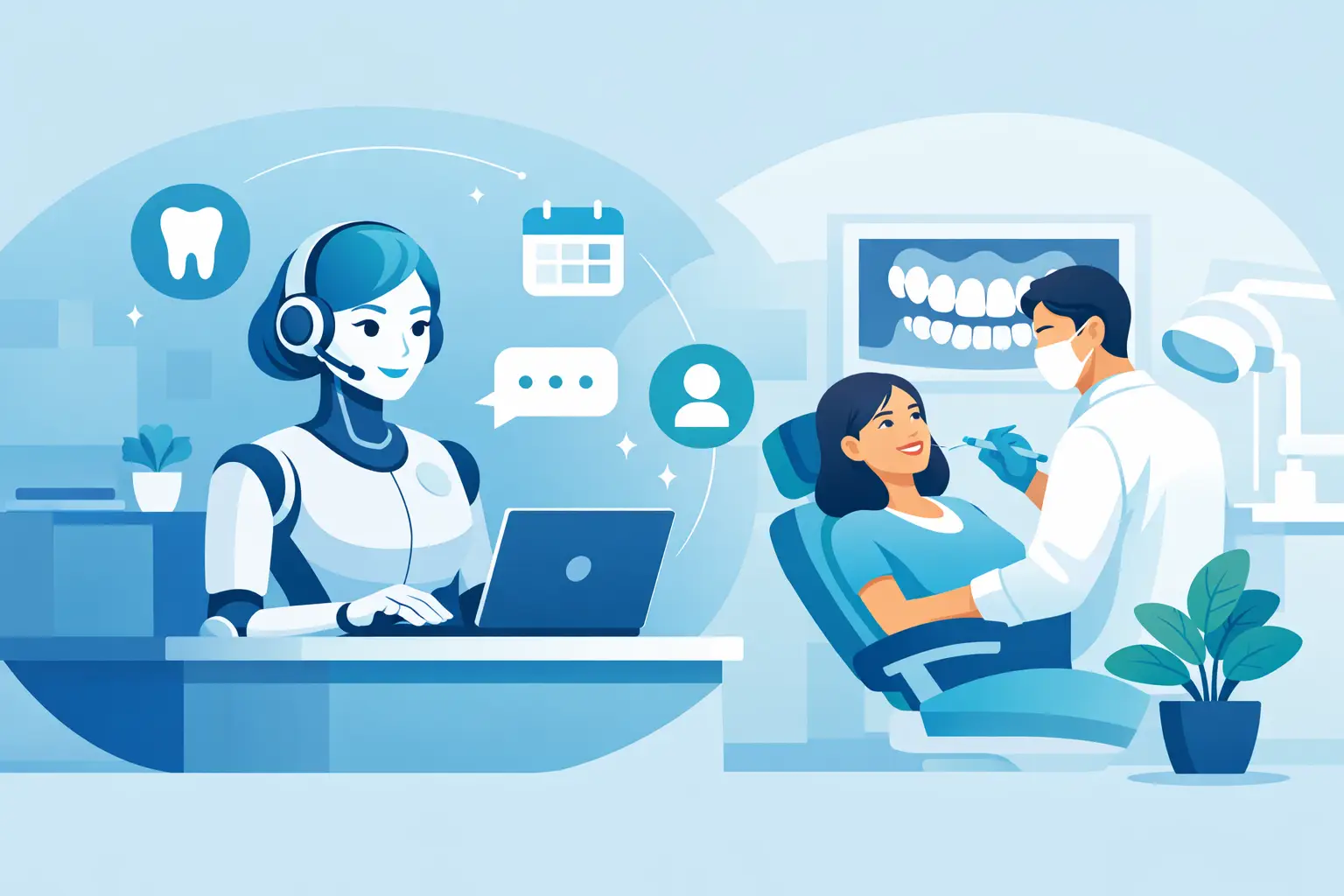
Monday at 8:07 a.m. is where most dental offices lose money. The phones light up, the front desk is checking in patients, insurance questions stack up, and three callers hang up before anyone can answer. This case study AI receptionist for dental office operations shows what happens when a practice stops treating phone coverage as a staffing problem and starts treating it as a conversion system.
The office in this example is a mid-sized general dentistry practice with two locations, six operatories per site, and a front desk team that was already working hard. The issue was not effort. It was capacity. Peak call windows collided with patient check-in, treatment coordination, billing questions, and recall scheduling. After-hours calls went to voicemail. Weekend inquiries sat cold until Monday. New patient demand existed, but the phone process leaked it.
The starting point: too many calls, not enough answer time
Before the change, the practice averaged roughly 1,900 inbound calls per month across both locations. Some were existing patients confirming appointments or asking billing questions. A meaningful share were new patient inquiries, emergency requests, and people trying to book fast. Those are the calls that matter most because they convert into production.
The problem was simple. The office could not answer every call live. During busy blocks, calls rolled to voicemail or rang out too long. Front desk staff had to choose between the patient standing in front of them and the one calling in. That is not a training problem. That is an operations bottleneck.
The leadership team tracked three pain points. First, missed calls were costing new appointments. Second, staff time was being consumed by repetitive scheduling conversations. Third, no one had a clean view of call patterns, abandoned calls, or how many opportunities were being lost outside business hours.
Why the office chose an AI receptionist
The practice did not need a novelty tool. It needed coverage that could answer instantly, book accurately, and hand off edge cases to a person when needed. That is where an AI receptionist made operational sense.
Instead of replacing the front desk, the office used AI to absorb the first layer of inbound call volume. The goal was to handle repetitive, high-frequency conversations at scale: new patient booking, appointment confirmations, office hours, location details, basic insurance screening, and urgent routing. More complex conversations could still transfer to staff.
This is the part many offices get wrong. AI works best when it is scoped around clear workflows, not treated like magic. For a dental office, that means defining exactly what the system should do, what it should not do, and when it should escalate.
How the AI receptionist was deployed
The setup focused on speed and control. The practice built call flows around its highest-value phone scenarios and connected the agent to its scheduling and CRM stack. Office hours, provider availability, accepted insurance plans, common procedures, financing FAQs, and location-specific instructions were loaded into the system so the voice agent could answer with practice-approved responses.
The AI receptionist was configured to handle inbound calls 24/7. During open hours, it could book, reschedule, answer common questions, or transfer live when needed. After hours, it could still capture new patient demand, triage emergencies, and book into available slots based on the office rules.
Because the practice had two locations, routing logic mattered. The system identified which location the caller wanted, offered the correct hours and directions, and booked into the right calendar. This removed a common source of front desk friction where calls bounced between sites or staff had to manually re-route them.
Reporting was also part of the rollout from day one. Call recordings, transcripts, booking outcomes, transfer events, and unanswered edge cases were reviewed weekly. That allowed the team to tighten scripts, improve FAQ coverage, and spot where human intervention was still needed.
Results after 90 days
Within the first 90 days, the office saw a measurable shift in both call performance and front desk workload.
Missed call rates dropped sharply because every inbound call was answered immediately, even during lunch, after hours, and on weekends. New patient bookings increased because callers no longer had to wait on hold or leave a voicemail and hope for a callback. The front desk team spent less time repeating hours, insurance basics, and scheduling details, which gave them more capacity for in-office service and higher-value conversations.
Here is what changed over the test period:
- Missed and abandoned calls fell by 41%
- New patient appointments booked by phone increased by 28%
- After-hours bookings accounted for 17% of total new patient appointments
- Average response time dropped to near-instant pickup
- Front desk staff recovered an estimated 22 hours per week from repetitive phone handling
Those numbers matter because they connect directly to revenue and labor efficiency. A dental office does not need every caller. It needs to capture qualified callers before they move to the next practice on Google. Fast answer time is often the difference.
What actually improved on the ground
The biggest win was not just more answered calls. It was a cleaner operating day.
Front desk staff were less interrupted during patient check-in and check-out. Treatment coordinators were not getting pulled into routine phone traffic. Existing patients received faster answers without sitting in a queue. New patients got a booking path immediately, which matters when someone is comparing providers in real time.
The office also found a benefit it did not expect: better consistency. Human teams vary by shift, workload, and experience level. An AI receptionist gives the same approved information every time, follows the same routing rules, and does not forget to ask for the insurance provider or preferred appointment window.
That consistency has limits, of course. AI should not be used to handle sensitive clinical advice or complex financial disputes without guardrails. In this practice, anything involving treatment interpretation, escalation risk, or unusual insurance complexity transferred to staff. That balance mattered. The system performed best as a high-volume front layer, not as a substitute for clinical judgment.
Where the ROI came from
For a dental office, the return did not come from one dramatic moment. It came from stacked efficiencies.
More calls were answered. More of those calls turned into appointments. Some of those appointments came in after hours, which meant the office captured demand that used to disappear into voicemail. At the same time, the team reduced the administrative drag of repetitive phone work.
If a practice books even a modest number of additional new patient visits each month, the math gets compelling fast. Add hygiene retention, restorative follow-up, and reduced staffing pressure, and the business case becomes very practical. This is why operations-minded leaders are adopting voice AI. It is not about replacing people. It is about making every incoming call easier to monetize and easier to manage.
Lessons from this case study AI receptionist for dental office teams can use
The office did a few things right that made the rollout work.
First, it started with narrow, high-frequency use cases. New patient booking, FAQs, appointment management, and after-hours coverage created immediate value. Second, it connected the AI receptionist to real systems so the agent could do the job instead of just collecting messages. Third, it reviewed transcripts and outcomes every week. Voice AI improves fast when operators treat it like a live revenue channel and tune it accordingly.
Another lesson is that scripting matters. The best results came from short, direct prompts and clear fallback rules. For example, if a caller said they were in pain, the system moved them into an urgent pathway. If they asked a question outside the approved knowledge base, it offered a transfer or callback route. Control produced better outcomes than trying to make the agent answer everything.
This is also where platform choice matters. A dental office needs more than a voice bot. It needs reliable telephony, calendar integration, reporting, multilingual support when patient populations require it, and human handoff when the conversation reaches a limit. That is the difference between a demo and a production system.
Is this model right for every practice?
Usually, yes, but the fit depends on call volume and workflow discipline. A single-location office with low phone traffic may get less immediate value than a busy multi-provider or multi-location group. Practices that already struggle with scheduling accuracy or fragmented calendars should fix those workflows first, or the AI will inherit the same chaos.
That said, most growing offices have the same issue: they are using people to absorb volume that should be automated. If your front desk is constantly triaging ringing phones, if weekend demand is going to voicemail, or if new patient calls are waiting too long, an AI receptionist is not a future project. It is an operations upgrade.
Platforms such as Cloud One-Ai are built for this exact gap – always-on phone coverage, controlled workflows, reporting, and direct integrations that let the agent do real work from day one.
The useful question is not whether AI can answer the phone. It can. The better question is whether your current phone process is converting as many patients as it should. If the answer is no, the next missed call is already costing you more than the software.