



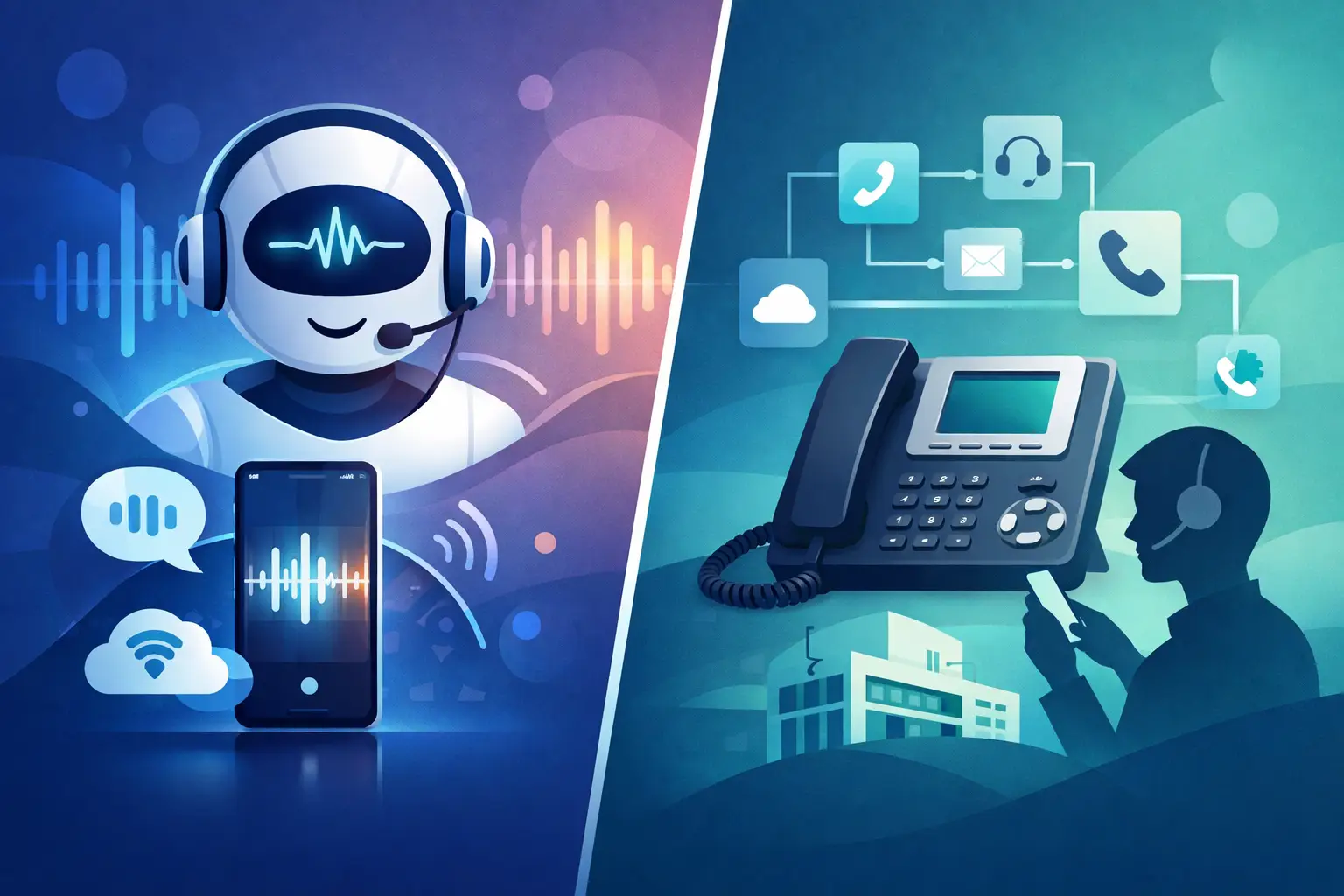
Every missed call has a price tag. In a dental office, it is an empty chair. In a law firm, it is a lead that calls the next firm. In a dealership, it is a test drive that never gets booked. That is why the question of voice AI vs IVR phone system is no longer technical. It is operational.
For years, IVR was the default answer. Press 1 for sales. Press 2 for support. Stay on the line. It helped businesses route calls without adding staff, but it also trained callers to expect friction. Voice AI changes that model. Instead of forcing people through a keypad tree, it lets them speak naturally, get answers faster, and complete real tasks on the call.
Voice AI vs IVR phone system: the core difference
An IVR phone system is rule-based. It follows a fixed menu and sends callers down predefined paths. That works when the goal is basic routing. It breaks down when customers ask open-ended questions, need to reschedule, want pricing, or speak in a way the menu did not anticipate.
Voice AI is conversational. It listens, understands intent, responds in real time, and can complete workflows like booking appointments, qualifying leads, sending follow-ups, or handing the call to a person with context attached. The difference is not just how the call sounds. It is what the system can actually do.
If your business only needs to route calls to three departments during business hours, IVR may be enough. If you need to answer after hours, capture revenue from inbound calls, run outbound campaigns, support multiple locations, or reduce repetitive call volume, voice AI is the stronger fit.
Where IVR still works
IVR is not obsolete. It is just limited.
For simple environments, IVR can be cost-effective and predictable. A small office with low call volume might use it to direct callers to the right extension. A utility or municipal service might use it to provide a few standard recorded options. In those cases, the menu structure is familiar, the requests are narrow, and the downside of a clunky experience is manageable.
IVR also gives operators a high degree of control. Every path is scripted. Every input is expected. Compliance teams sometimes like that rigidity because it reduces variation.
But that same rigidity becomes the problem when your calls affect revenue, scheduling, intake, renewals, or customer satisfaction. The more dynamic the conversation, the less useful a rigid phone tree becomes.
Why more businesses are moving to voice AI
Customers do not call because they want a menu. They call because they want an answer.
Voice AI meets that expectation in a way IVR cannot. A caller can say, “I need to reschedule my appointment for Friday,” or “Do you take walk-ins?” or “I want to know if this car is still available,” and the system can respond without forcing them through six button presses first.
That matters because speed changes outcomes. Faster responses mean fewer abandoned calls. Better call handling means more booked appointments. Consistent follow-up means fewer missed opportunities. For operations teams, this is not about novelty. It is about reducing queue pressure, lowering manual workload, and capturing demand that would otherwise leak out.
A modern voice AI platform can also do more than talk. It can pull from your knowledge base, update a CRM, write to a calendar, trigger a text message, and route the call to a human when needed. That turns the phone line from a routing layer into a working part of your business stack.
Voice AI vs IVR phone system for real business use cases
In healthcare and dental, IVR can tell a patient which office to call. Voice AI can confirm insurance basics, answer common questions, book appointments, send reminders, and transfer urgent cases to staff. That reduces front-desk overload while keeping the schedule full.
In salons, spas, and restaurants, IVR often creates drop-off because callers want quick answers now. Voice AI can handle booking, cancellations, business hours, service questions, and overflow calls during peak times. That means fewer missed bookings during lunch rushes or after-hours demand.
In real estate and legal intake, speed matters even more. An IVR tree can route a prospect. Voice AI can qualify the lead, capture case details or property preferences, and push the information into the right system before the prospect loses interest.
In sales and call center environments, the gap widens. IVR was built for inbound routing. Voice AI can support inbound and outbound operations, from lead qualification and follow-ups to renewals, upsells, and appointment setting. If your team needs to make or receive calls at scale, that flexibility is hard to ignore.
The trade-offs you should actually care about
Voice AI is more capable, but capability should not be confused with fit.
If your processes are poorly defined, deploying voice AI without guardrails can create inconsistent outcomes. You still need clear scripts, escalation rules, knowledge boundaries, and reporting. The best systems make that easier with no-code controls, human handoff, and call analytics, but setup still matters.
IVR, on the other hand, is simpler to understand because it does less. That can mean fewer surprises, but it also means more dead ends for callers and more work pushed back onto your staff.
There is also the customer expectation factor. Some audiences are comfortable with touch-tone menus because they have dealt with them for years. Others will abandon the call the moment they hear one. If your business competes on responsiveness, old-school routing can make you look slower than you actually are.
The practical question is this: do you need a system that routes calls, or a system that resolves them?
Cost is not just software cost
A lot of businesses compare voice AI and IVR by subscription price alone. That misses the real math.
IVR may look cheaper on paper, but it often shifts costs into staffing, missed calls, abandoned leads, after-hours gaps, and manual follow-up. You save on software while losing on operations.
Voice AI usually has a higher capability ceiling and may come with usage-based pricing, but it can replace repetitive call handling, reduce front-desk pressure, extend coverage to nights and weekends, and increase the percentage of calls that end in a booked appointment or qualified lead. That is where ROI shows up.
For multi-location operators, the economics can tilt even faster. A single voice AI setup can standardize call handling across locations, languages, and time zones while feeding the same CRM and calendar stack. That is difficult to replicate with a basic IVR setup and fragmented manual processes.
What to look for if you choose voice AI
Not every voice AI platform is enterprise-ready. Some sound impressive in a demo and fall apart when real customers ask real questions.
Look for multilingual support if your callers speak more than one language. Look for integrations that connect directly to your CRM, calendar, and operational systems. Look for reporting that includes recordings, transcripts, and outcome tracking so you can improve performance instead of guessing. Look for human handoff so staff can step in without making the customer repeat everything.
Capacity matters too. If your business gets call spikes, the platform should handle parallel calls without creating a bottleneck. If you want outbound campaigns, it should support those natively instead of forcing you into another tool. And if you are an agency or reseller, white-label controls, subaccounts, and billing options are not extras. They are the business model.
That is where a platform approach stands out. Cloud One-Ai, for example, is built as an AI call center rather than a narrow voice bot. That means inbound, outbound, reporting, integrations, knowledge ingestion, and human transfer in one system. For operators, that reduces tool sprawl and shortens time to deployment.
So which one wins?
In the debate of voice AI vs IVR phone system, IVR wins when the job is basic routing and nothing more. It is familiar, rigid, and serviceable for low-complexity call flows.
Voice AI wins when calls drive revenue, scheduling, support quality, or lead conversion. It answers faster. It handles more nuance. It works after hours. It scales without adding headcount at the same rate. Most importantly, it moves the phone system closer to the outcome the caller actually wants.
If your team is still spending valuable hours answering the same questions, chasing missed calls, or losing leads after business hours, the real risk is not switching too early. It is waiting while the call volume keeps telling you what the old system cannot do.
The best phone system is the one that removes friction from the moment someone calls. If that matters to your business, the gap between IVR and voice AI is not small. It is the difference between routing demand and converting it.