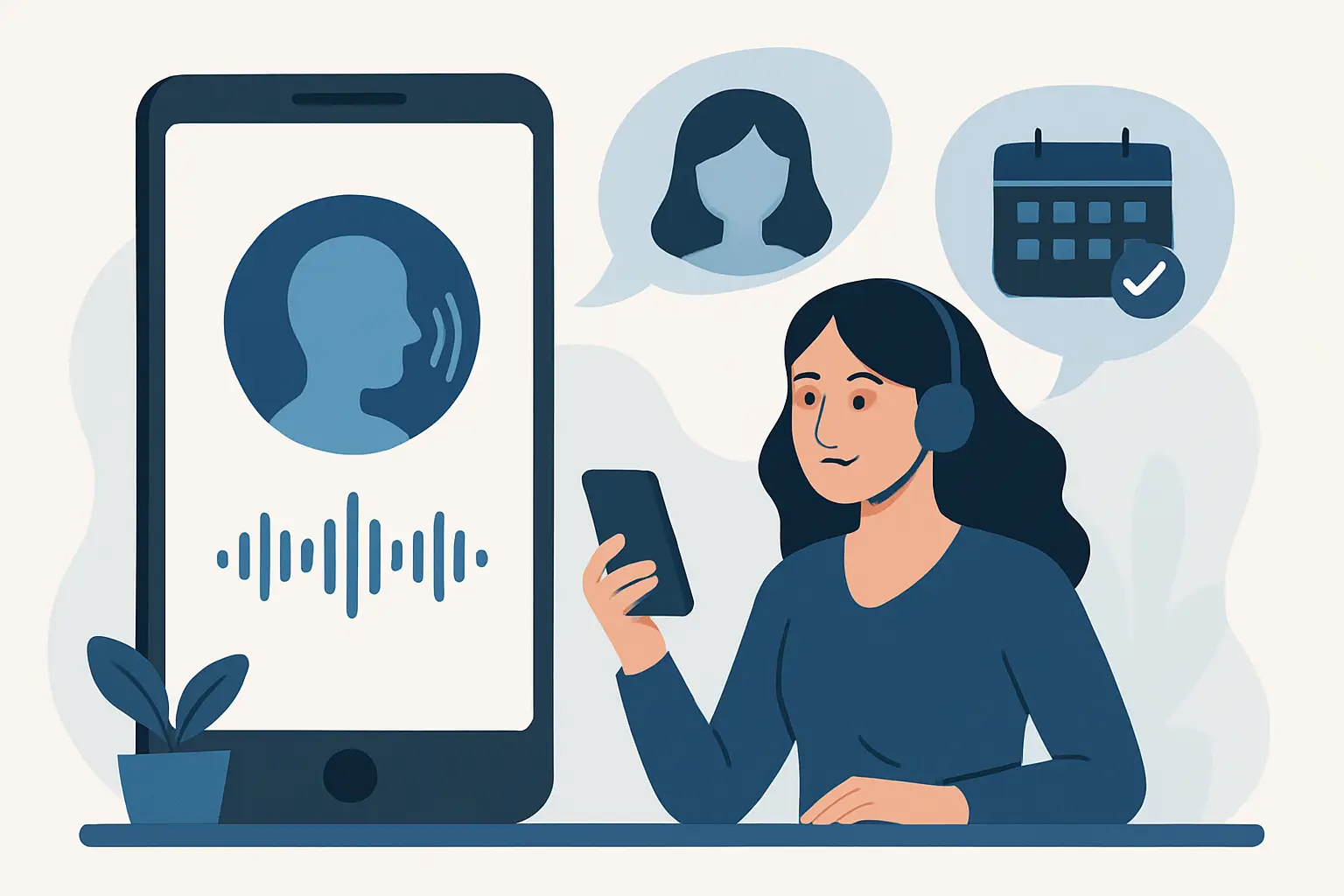
A customer calls at 12:07 pm, right when your front desk is checking someone in, taking a payment, and answering a second line. The caller hears ringing, gets sent to voicemail, and hangs up. That was not “a missed call.” That was a missed appointment, a missed upsell, and often a missed review.
That is exactly where an ai voice agent for appointment booking earns its keep – not as a novelty, but as infrastructure that protects revenue when humans are busy.
Think of it as a phone-first scheduler that speaks naturally, handles interruptions, and completes the full loop: answer, identify, qualify, book, confirm, and log the outcome.
On a typical inbound call, the agent can greet the caller, detect intent (“I need to book,” “I need to reschedule,” “What are your hours?”), and then move into booking mode. It offers real availability, captures required details, applies your rules (new patient vs. returning, insurance accepted, service duration, provider preference), and sends confirmations by SMS or email.
The operational difference versus “press 1 for appointments” is that the caller does not have to fight a phone tree. They just talk. And the business does not have to rely on someone remembering to call back voicemails later.
Appointment workflows have three qualities that make them ideal for automation.
First, they are repetitive. The same questions come up all day: “Do you have anything today?”, “Can I book for Friday?”, “What do I need to bring?”, “How much is it?” Repetition is where automation wins.
Second, speed is the product. If you answer in seconds and book in minutes, you beat the competitor who responds in two hours. That shows up in conversion rate, not just customer satisfaction.
Third, the output is measurable. Booked appointments, no-shows, reschedules, abandoned calls, average handle time – you can tie voice automation to real operational KPIs.
Not all voice agents are built for appointment revenue. Some are good at “talking” but weak at completing the booking.
If the agent is only collecting details and promising a callback, you did not solve the problem. You moved the problem.
A true booking agent checks calendar availability in real time (Google Calendar, Outlook, Calendly, Cal.com, or your practice system via integration), books the slot, and confirms it on the call.
The busiest time is when you need coverage most. If a platform can only handle one call at a time, you still lose callers when the line is hot. Look for capacity that supports spikes – for multi-location operators, parallel handling is often the difference between “nice to have” and “this pays for itself.”
Booking the appointment is step one. Step two is making sure the rest of your operation sees it.
You want the agent to create or update the contact in your CRM, tag the lead source, write call notes, and trigger follow-up workflows. When that is automated, your staff stops retyping names, phone numbers, and appointment reasons all day.
Customers do not just book. They ask questions mid-call: cancellation policy, location details, prep instructions, pricing ranges, service eligibility.
A strong voice agent can pull answers from approved sources (documents, FAQs, web pages) so it stays on-brand and accurate. This matters most in regulated or high-stakes environments like healthcare and legal offices where “close enough” answers create risk.
Automation is not the goal. Completion is.
There will be calls that should transfer: complex billing issues, upset customers, clinical triage, high-value leads, edge-case scheduling rules. A good system hands off with context – who called, what they want, what has been collected – so your team is not starting from zero.
Voice AI is not magic. It is operations.
It wins when calls are frequent, time-sensitive, and structured. Dental offices booking cleanings, med spas booking consults, dealerships scheduling service, property managers booking tours, home services scheduling estimates – these are high-volume patterns with clear next steps.
It struggles when the business has no real scheduling rules and everything is “we’ll figure it out.” If your team regularly double-books to “squeeze people in,” or your availability lives in someone’s head, the agent will reflect that chaos. Voice automation forces you to define what “available” means.
It also depends on how often your callers ask for exceptions. The more exceptions you allow, the more you will rely on handoff or custom logic. That is fine, but it should be a deliberate choice.
You can deploy fast without being sloppy. The goal is a booking agent that behaves like your best scheduler on their best day.
Start with one location or one service line that represents meaningful call volume. Define the booking rules in plain English: operating hours, appointment types, durations, buffers, provider assignment rules, and what to do when nothing is available.
Next, decide what the agent must collect before booking. For healthcare, that may include new vs. returning patient, insurance type, and reason for visit. For salons, it might be service type, stylist preference, and any add-ons.
Then connect the calendar and the system of record. If you run on a CRM like HubSpot, GoHighLevel, or Zoho, make sure the agent creates a contact, logs the call, and sets the next action automatically. That is where the time savings compounds.
Finally, implement confirmations and reminders. Booking is good. Show rate is better. Simple reminders, reschedule links, and confirmation texts reduce no-shows without your staff chasing people.
If you cannot measure it, you cannot scale it.
Track missed calls before and after. Most businesses underestimate how many calls ring out, hit voicemail, or get abandoned. Your voice agent should drive that number down because it answers immediately.
Track booking conversion rate from inbound appointment-intent calls. This is the cleanest metric because it reflects the agent’s primary job.
Watch average handle time, but do not obsess over making calls shorter. A slightly longer call that results in a booked appointment is a win.
Pay attention to transfer rate. Too many transfers means your rules are unclear or your agent lacks access to the right information. Too few transfers can mean the agent is “confidently wrong,” which is worse.
And review call recordings and transcripts weekly. Not to micromanage, but to catch patterns: callers asking for the same info you did not include in the knowledgebase, confusion around certain appointment types, or a policy that is causing friction.
In a dental clinic, a voice agent can handle new patient calls after hours, capture insurance information, book the first available exam slot, and send prep instructions. It can also reschedule hygiene appointments without staff intervention, which quietly saves hours every week.
In a multi-location med spa, the biggest win is speed to lead. The agent answers campaign-driven calls instantly, qualifies for the right service, and books a consult across the nearest location. When volume spikes, parallel call handling keeps you from burning ad spend on voicemails.
In automotive service, the agent can book oil changes and standard maintenance, then transfer anything involving warranty disputes or complex diagnostics. The service department gets fewer interruptions and more filled bays.
In legal offices, the agent can qualify lead type, capture basic case details, and schedule a consult. But it should be strict about what it answers from the knowledgebase and what gets handed off, because precision matters.
Ask whether the agent can truly book in real time, or if it is just taking messages.
Ask how many simultaneous calls it can handle without degrading quality.
Ask how it learns your policies: can it ingest PDFs, internal docs, or approved website pages, and can you control what it is allowed to use?
Ask what reporting you get by default: recordings, transcriptions, outcomes, and funnel metrics.
And ask how handoff works. If you cannot transfer cleanly, your team will resent the system instead of trusting it.
If you want an all-in-one AI call center that can answer inbound appointment calls, run outbound follow-ups, support multilingual callers, and connect to your CRM and calendars through hundreds of integrations, Cloud One-Ai is built for that operations-first use case. It is designed to deploy quickly, handle high call concurrency, and give you the reporting and governance you need to treat voice as a measurable channel.
A voice agent is not there to replace your staff’s judgment. It is there to eliminate the dead time – ringing phones, voicemails, call-backs, and repetitive scheduling steps that drain attention from the customers already in front of you.
The helpful mindset shift is simple: treat your phone line like a revenue system, not a shared inbox. When every call gets answered, every booking gets logged, and every outcome gets measured, appointment growth stops feeling like luck and starts looking like process.