



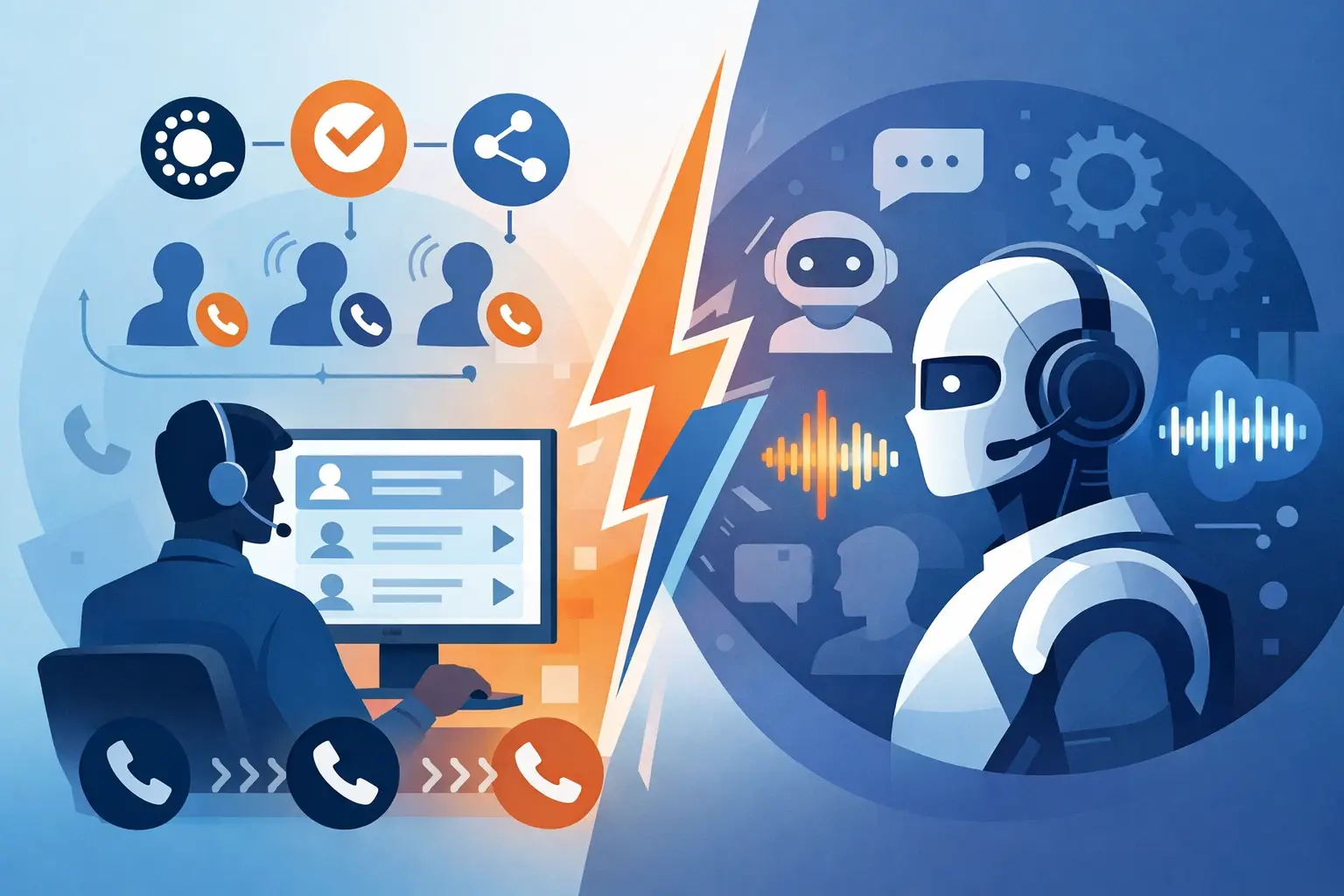
If your team is still measuring success by how many numbers get dialed per hour, you may be optimizing the wrong part of the call workflow. The real question in predictive dialer vs voice AI is not which tool places more calls. It is which one turns more conversations into booked appointments, qualified leads, and resolved customer issues without adding headcount.
For sales teams, clinics, dealerships, agencies, and multi-location operators, that difference matters fast. A predictive dialer helps human agents talk to more people by automating call pacing. Voice AI goes further. It can answer, qualify, book, follow up, route, and document calls on its own. Both have value. They solve different operational problems.
Predictive dialer vs voice AI: the core difference
A predictive dialer is built to maximize agent talk time. It calls multiple numbers at once, predicts when a live person will answer, and routes connected calls to available reps. The goal is simple: reduce idle time and increase outbound volume.
Voice AI is built to handle the conversation itself. It uses AI voice agents to speak with callers in natural language, follow workflows, collect data, answer common questions, and trigger actions in your systems. The goal is not just more calls. It is more completed call tasks.
That distinction changes how each system performs in the real world. If your team already has trained agents ready to take live transfers all day, a predictive dialer can improve efficiency. If your business loses revenue to missed calls, after-hours demand, repetitive qualification, or inconsistent follow-up, voice AI addresses the bigger gap.
Where predictive dialers still make sense
Predictive dialers are not outdated. They are just narrower in scope than many buyers expect.
In a high-volume outbound sales floor, especially one built around live human closers, a predictive dialer can still be effective. Collections teams, political outreach operations, and some call centers use dialers because agent availability is the constraint. The software keeps reps fed with live calls so they spend less time waiting and manually dialing.
That works best when scripts are straightforward and the economics support staffing. It also assumes you are comfortable with the trade-offs: abandoned calls, variable answer quality, agent burnout, and the constant need to manage pacing, compliance, and list hygiene.
A dialer improves throughput. It does not replace the labor required to actually run the conversation.
Where voice AI pulls ahead
Voice AI performs best when the call itself contains repeatable work. That includes booking appointments, confirming visits, qualifying leads, answering service questions, collecting intake details, chasing no-shows, reactivating old leads, and routing urgent cases.
For a dental office, that might mean answering every inbound call, checking availability, and booking directly into the calendar. For a real estate team, it could mean calling new leads within seconds, asking qualification questions, and routing warm prospects to an agent. For a dealership, it could mean handling service reminders and missed-call recovery after hours.
This is where the comparison shifts from call volume to operating leverage. A voice AI system can run 24/7, handle parallel conversations, and push outcomes into your CRM or scheduling tools without waiting for a rep to be free. Instead of helping a human do more calls, it removes many calls from the human queue altogether.
Cost is not just software cost
Most buyers compare pricing line items first. That misses the larger cost equation.
A predictive dialer may look cheaper on paper if you only compare subscription fees. But it usually sits on top of labor. You still need agents, supervisors, QA, training, schedule coverage, and call handling capacity for spikes. If your answer rates rise, staffing pressure rises with them.
Voice AI changes that model. You are paying for automation capacity, not just dialing infrastructure. That means the ROI often comes from labor avoidance, faster response times, higher contact consistency, and better capture of after-hours demand. If one missed inbound lead is worth hundreds of dollars, the cheapest system is not the one with the lowest monthly fee. It is the one that prevents revenue leakage.
This is especially true for service businesses where every call can become an appointment. A system that answers instantly and books directly can outperform a cheaper dialer plus front-desk overflow simply because it closes the response gap.
Lead quality and customer experience
Predictive dialers are optimized for speed. Voice AI is optimized for speed plus handling.
That matters because fast outreach alone does not guarantee better outcomes. If a live answer reaches an agent who is rushed, inconsistent, or missing context, conversion suffers. If no agent is available and the call is dropped or delayed, the contact opportunity is wasted.
Voice AI can standardize the first interaction. Every lead gets the same prompt follow-up, the same qualification flow, and the same next step. That consistency is hard to maintain across large teams or rotating staff.
Customer experience also changes. Many businesses still treat inbound calls and outbound follow-up as separate workflows. Customers do not see it that way. They expect immediate answers, short hold times, and no repetition. Voice AI can connect those touchpoints because it can answer inbound calls, trigger outbound callbacks, log the conversation, and hand off to a human with full context.
A predictive dialer cannot do that by itself. It accelerates dialing. It does not unify the customer journey.
Compliance and control in predictive dialer vs voice AI
This is one area where buyers should slow down and ask better questions.
Both systems touch regulated workflows. Both need guardrails. But the risk profile is different.
With predictive dialers, the common concerns are pacing rules, abandoned calls, consent management, call recording disclosures, and agent behavior. Compliance often depends on how well supervisors manage the live team.
With voice AI, the focus shifts to script control, approved knowledge sources, transfer logic, consent flows, reporting, and auditability. The upside is that AI systems can be more controlled than human teams when configured correctly. They do not improvise outside the workflow unless you let them. They can be constrained to approved answers, specific call actions, and defined escalation paths.
For operations leaders, that level of control is often a strength, not a weakness. The right platform makes it easier to review transcripts, track outcomes, and improve performance without listening to hours of random calls.
The integration question most teams overlook
A calling tool without integrations creates more admin work. That is true whether you buy a dialer or voice AI.
Predictive dialers usually integrate at the lead list and disposition level. They can pull contacts from a CRM and push call outcomes back. Useful, but limited.
Voice AI becomes much more valuable when it connects directly to calendars, CRMs, help desks, forms, and internal systems. That is how an AI voice agent moves from conversation to action. It does not just say the appointment is booked. It books it. It does not just qualify a lead. It updates the record, tags the outcome, and triggers the next workflow.
That integration depth is what turns voice AI into an operational layer instead of a front-end novelty. For businesses that care about speed to lead, no-show reduction, multilingual support, and call reporting, this is usually the deciding factor.
Which one should you choose?
Choose a predictive dialer if your business already depends on live agents, your main problem is idle rep time, and your outbound process is human-led from start to finish. It is a fit for teams that want more connected calls but are not trying to automate the conversation itself.
Choose voice AI if you want to automate repetitive call tasks, respond instantly at any hour, scale without adding seats, and connect calls directly to business systems. It is a better fit when your bottleneck is not dialing volume but follow-up speed, staffing coverage, missed calls, or inconsistent execution.
For some organizations, the answer is both. A sales floor may keep a predictive dialer for closers while using voice AI to pre-qualify leads, recover missed calls, confirm appointments, and handle overflow. That hybrid setup makes sense when you want humans focused on high-value conversations and automation handling the repeatable work around them.
For many SMBs, though, the choice is simpler than it looks. If you do not have a large outbound team to feed, a predictive dialer may solve a problem you barely have. Voice AI often maps better to the day-to-day reality: phones ringing when staff are busy, leads going cold after hours, repetitive front-desk calls, and follow-ups that slip through the cracks.
That is why more operators are moving past dialing efficiency and looking at full call automation. Platforms like Cloud One-Ai are built around that shift – not just placing calls, but running inbound and outbound workflows, booking into calendars, syncing with CRMs, handling multiple calls at once, and transferring to a human when needed.
The best system is the one that removes friction from revenue-generating conversations. If your business wins or loses on phone speed, consistency, and coverage, start there. The call volume metric will take care of itself.