



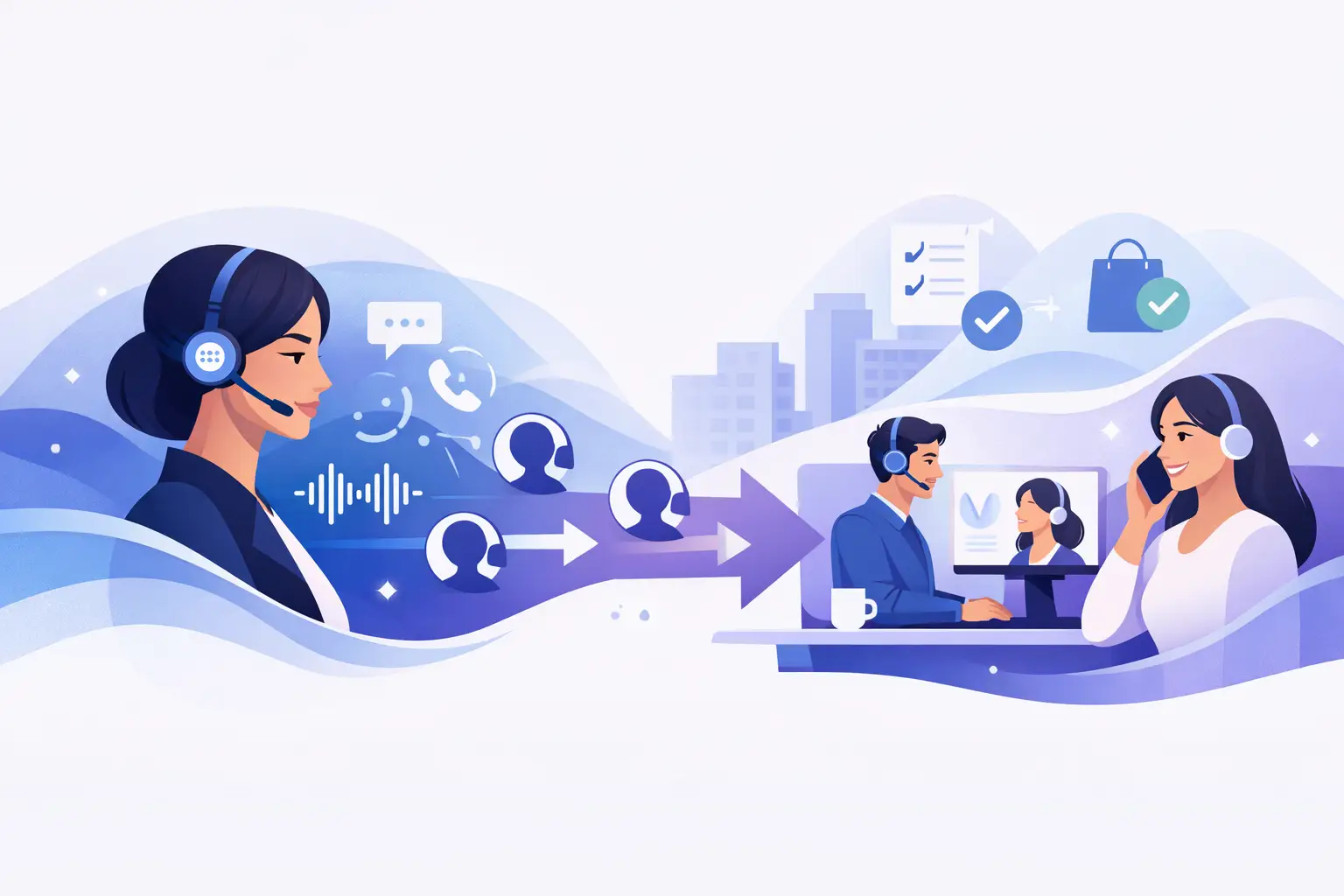
Monday at 8:07 a.m. is when a lot of revenue disappears.
The phones light up, the front desk is already helping someone in person, two callers hang up after a long ring, and a third goes to voicemail and never calls back. That is the real cost of missed demand. An ai voice agent for call overflow fixes that specific problem by answering instantly when your team is busy, after hours, or hit with a call spike.
This is not about replacing good staff. It is about protecting the moments when your staff cannot physically answer every call. For service businesses, clinics, legal offices, dealerships, and sales teams, overflow is where conversion rates quietly fall apart. The right system keeps the line moving, captures intent, books the next step, and transfers only the calls that need a person.
What an AI voice agent for call overflow actually does
At a practical level, call overflow means one thing: when call volume exceeds available staff, another system steps in. The old version was voicemail, an answering service, or a rigid phone tree. The better version is an AI voice agent that can hold a real conversation, follow business rules, and complete tasks inside your workflow.
That means it can answer common questions, collect lead details, book appointments, qualify urgency, route based on department, and hand off to a human when needed. If your office gets ten calls at once, the AI does not get flustered. It can handle parallel conversations and keep response times consistent.
That consistency matters more than most teams realize. A caller who gets an answer in the first few seconds is more likely to stay on the line, give accurate information, and accept the next step. A caller who hears ringing, gets bounced around, or lands in voicemail is already halfway out the door.
Why call overflow is a revenue problem, not just a staffing problem
A lot of businesses frame overflow as a scheduling issue. It is bigger than that. Every missed or delayed call can affect bookings, intake, renewals, show rates, and customer trust.
A dental office may lose a new patient consult because no one answered during lunch. A restaurant may miss reservations during peak hours. A law firm may fail to capture a high-intent intake because reception was already on another line. A dealership may lose a sales opportunity because after-hours leads were sent to voicemail instead of getting immediate help.
Hiring more staff is not always the clean answer. It increases fixed cost, training burden, and schedule complexity. It also does not solve evenings, weekends, holidays, or sudden bursts in demand. An AI voice agent gives you variable coverage without adding another full-time seat every time call volume climbs.
There is a trade-off, of course. Not every interaction should be automated. Sensitive escalations, complex objections, and certain compliance-heavy conversations still belong with trained people. The point is to automate the repeatable middle: the calls that need speed, structure, and accurate routing.
Where an ai voice agent for call overflow works best
Overflow automation performs best when the business has repeatable phone workflows and clear next actions. That is why it fits industries where every incoming call has a predictable purpose.
Healthcare practices use it to confirm insurance basics, schedule appointments, route urgent callers, and answer common location or prep questions. Salons and med spas use it to book services, answer pricing questions, and fill canceled slots. Real estate teams use it to qualify leads and route by listing, market, or agent availability. Legal offices use it to collect intake details and flag urgent matters for live transfer.
Sales organizations get a different advantage. Overflow does not only happen at the front desk. It also happens in inbound lead response. If your reps are on calls and a fresh lead calls in, the AI can answer immediately, qualify intent, collect budget or timeline, and assign follow-up inside your CRM before interest cools off.
The difference between a useful agent and a frustrating one
Not every AI phone setup improves operations. Some simply move the frustration around.
A useful overflow agent sounds natural, understands interruptions, and knows when to stop talking and transfer. It has access to your business information, your availability, and your routing rules. It can work in multiple languages if your caller base requires it. Most important, it can complete actions, not just recite answers.
That action layer is where many systems fail. If the AI can answer questions but cannot book into your calendar, log the call in your CRM, or trigger a follow-up workflow, your team still has to clean up the interaction manually. That limits the ROI.
The strongest setups connect telephony, conversation logic, scheduling, CRM updates, and reporting in one workflow. That is what makes an AI voice agent operationally useful instead of just interesting in a demo.
How to deploy call overflow without creating chaos
The fastest rollout is usually the most focused one. Start with one call path, not every scenario at once.
A strong first use case is missed calls during business hours. Set the AI to answer when no one picks up after a set number of seconds or when all agents are busy. Give it a narrow job: identify the caller, understand the reason for the call, complete the booking or intake if possible, and transfer urgent cases.
After that, expand to after-hours coverage, weekend routing, and peak-time overflow. Once those are stable, add FAQs, multilingual support, and outbound follow-up for abandoned calls or no-shows.
This staged approach matters because real phone operations always have exceptions. You may need different scripts for existing customers and new leads. You may need one routing path for billing and another for emergency maintenance. You may want strict human handoff rules for legal or medical sensitivity. Start with the highest-volume repeatable scenario and build from there.
What to look for in an AI voice agent for call overflow
If call handling affects revenue, the buying criteria should be operational, not cosmetic.
First, make sure the system can handle concurrent calls. Overflow only works if the platform can absorb spikes instead of creating a new queue. Second, verify that it integrates with the systems your team already uses, especially calendars, CRMs, and ticketing tools. Third, check reporting depth. You need recordings, transcripts, call outcomes, and trend visibility so you can improve scripts and staffing decisions.
Human handoff is another non-negotiable. The AI should know when confidence is low, when sentiment turns negative, or when the caller requests a person. It should transfer with context so the human is not starting from zero.
Knowledge control also matters. If the agent is trained on your website, PDFs, or policy documents, you need clear boundaries around what it can say. That is especially important in regulated or high-trust industries.
A platform like Cloud One-Ai is built around that operations-first model: inbound and outbound voice agents, parallel call handling, multilingual coverage, knowledgebase ingestion, reporting, integrations, and live transfer when the moment calls for a person. That combination is what turns overflow from a patch into a real call center layer.
The ROI shows up faster than most teams expect
The obvious gain is fewer missed calls. But the bigger return usually comes from faster response and better conversion.
When callers get immediate help, more of them stay engaged. More appointments get booked on the first interaction. More leads get qualified before they disappear. Staff spend less time repeating the same basic answers and more time on the conversations that need judgment.
There are softer benefits too. Managers get cleaner reporting on peak hours, missed-call patterns, and call reasons. Multi-location businesses can standardize call handling without forcing every site to solve the problem alone. Agencies and consultants can also package overflow automation as a sellable service instead of stitching together telephony, AI, and workflow tools from scratch.
The trade-off is that performance depends on setup quality. A bad script, weak routing logic, or poor integration design will hurt the caller experience. That is why the best results come from a platform that lets you control prompts, handoff conditions, business rules, and downstream actions without needing an engineering team.
Start with the calls you are already losing
You do not need to redesign your entire phone operation on day one. Start where the leaks are easiest to see: lunch-hour overflow, after-hours calls, weekend inquiries, seasonal spikes, and the first ring that nobody catches.
If your phones are part of how you book revenue, overflow is not a side issue. It is conversion infrastructure. The right AI voice agent answers now, routes correctly, updates your systems, and gives your team room to focus on higher-value work.
The best part is simple: callers do not care whether your volume is unusually high. They only care whether someone helpful answered. Make sure the answer is yes.