



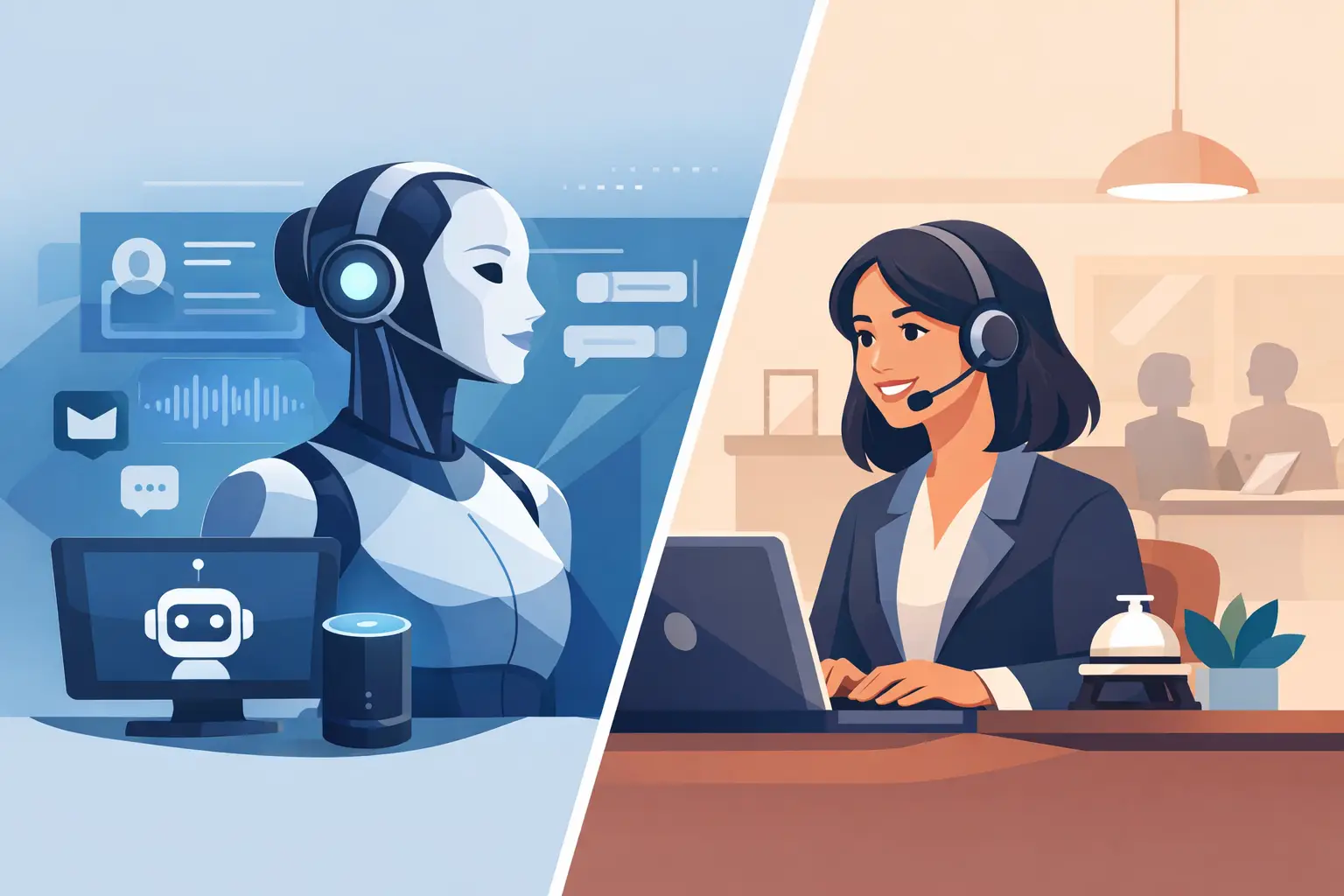
The phone rings at 12:07 p.m. while your front desk is checking in a patient, answering a billing question, and trying to call back a no-show. That one missed call might have been a new booking, a high-value case, or a customer ready to buy. This is where the real ai receptionist vs live receptionist decision starts – not with theory, but with lost revenue, staff overload, and response time.
For businesses that depend on inbound calls, the question is not which option sounds better in a sales pitch. The question is which one helps you answer faster, book more, and keep operations under control without adding unnecessary labor. In many cases, the best answer is not fully human or fully automated. It is a call workflow built around what each does best.
AI receptionist vs live receptionist: what actually changes?
A live receptionist brings judgment, emotional awareness, and flexibility. They can catch context quickly, calm down an upset caller, and handle edge cases that do not fit a script. For legal offices, medical practices, dealerships, and service businesses with nuanced conversations, that matters.
An AI receptionist brings availability, speed, and scale. It answers every call, works after hours, handles repetitive requests without fatigue, and follows the same process every time. It does not call out sick, it does not get pulled away by walk-ins, and it can manage multiple calls at once instead of forcing customers into hold queues.
That difference changes the economics of the front desk. A live receptionist is a person you hire, train, schedule, and backfill. An AI receptionist is infrastructure. It becomes part of your operating system for calls, especially when it connects to calendars, CRMs, and support workflows.
Where a live receptionist still wins
There are situations where a human should stay in the lead. If your business regularly handles emotionally charged calls, complex intake, sensitive compliance scenarios, or high-trust conversations, a live receptionist still has an advantage.
Think about a family law office fielding urgent consultations, a specialty medical practice discussing patient concerns, or a luxury real estate team handling high-net-worth leads. In those moments, tone and judgment are not just nice to have. They directly affect conversion and trust.
A live receptionist is also stronger when your processes are messy. If your scheduling rules change every week, your team gives exceptions constantly, or your internal systems are not documented, a person can improvise around the chaos in a way automation cannot.
But that flexibility comes at a cost. Humans vary. One receptionist may be excellent at lead qualification while another forgets to log details. Coverage drops at lunch, after hours, on weekends, and during turnover. If call volume spikes, performance usually drops with it.
Where AI wins on operations
If you measure the front desk like an operations leader, AI solves problems that staffing alone struggles to solve.
First is coverage. Calls do not arrive on a clean 9-to-5 schedule. They come in early, late, during breaks, and all at once. An AI receptionist can answer 24/7 and handle parallel conversations, which is a major advantage for businesses that lose leads when phones go unanswered.
Second is consistency. AI follows your approved script, asks required questions, logs the same data every time, and routes calls based on clear logic. That matters for appointment booking, lead qualification, FAQs, follow-ups, rescheduling, and payment reminder calls.
Third is speed to response. Customers do not want voicemail. They want an answer now. If AI can greet the caller instantly, verify intent, pull business information from a knowledge base, and either complete the task or transfer to staff, you reduce abandonment and improve booking rates.
Fourth is cost structure. A live receptionist is not just salary. It is payroll burden, turnover, training time, coverage gaps, and management overhead. AI usually shifts that into a more predictable operating expense tied to usage and workflow scope.
For a multi-location business, the gap gets wider. Centralized AI handling across locations can standardize intake, booking, FAQs, and routing in a way that is difficult to maintain with separate front-desk teams.
Cost is only part of the ai receptionist vs live receptionist debate
Many buyers start with labor savings, but cost alone is too narrow. The better question is what each model does to your conversion rate, show rate, staff utilization, and missed-call rate.
A lower-cost system that frustrates callers can still be expensive. A higher-cost human team that misses 20 percent of inbound opportunities can be even more expensive.
If your business gets a high volume of repeatable calls like booking requests, business hours, service availability, reschedules, lead screening, and basic support, AI usually improves unit economics quickly. It handles the repetitive volume so your staff can focus on exceptions, upsells, and conversations where human skill actually moves the result.
If your business gets fewer but more complex calls, a live receptionist may generate better outcomes per interaction. The trade-off is that scaling those interactions requires more people, more scheduling, and more operational discipline.
The best model for most businesses is hybrid
For most SMBs and service operators, this is not an either-or decision. It is a routing decision.
Use AI as the first layer. Let it answer instantly, capture intent, verify details, answer common questions, qualify leads, and book straightforward appointments. Then route high-value or sensitive calls to a person with full context.
That hybrid model does three things well. It protects revenue by eliminating missed calls. It reduces front-desk overload by removing repetitive work. And it keeps a human available where judgment matters most.
This is especially effective in healthcare, dental, legal, automotive, and home services, where the call mix is predictable enough to automate a large share of volume but varied enough that some conversations still need human control.
A platform like Cloud One-Ai fits that model well because it is built for both automation and handoff. The practical value is not just that an AI voice can answer. It is that the call can connect into calendars, CRMs, and operating systems, pull from approved business knowledge, and transfer to a human when the workflow reaches a boundary.
What to evaluate before choosing
The wrong decision usually happens when businesses compare appearance instead of workflow fit. A better evaluation starts with your call data.
Look at why people call, when they call, how many calls are missed, how often staff puts callers on hold, and which conversations actually require human judgment. You will often find that a large percentage of calls are repetitive and rules-based.
Then look at integration needs. If your receptionist process depends on checking a calendar, creating a lead, updating a CRM record, verifying office hours, or triggering a follow-up, AI becomes much more valuable when it can act inside those systems instead of just answering questions.
You should also evaluate language coverage. For businesses serving multilingual communities, a live receptionist team may not be able to cover every language or accent consistently. AI can expand coverage much faster, which is a direct service advantage in many US markets.
Finally, think about reporting. With live reception alone, call quality is hard to audit at scale unless you build a formal QA process. AI-driven call handling can give you transcripts, recordings, outcomes, and trend reporting by default. That turns your front desk from a black box into something you can improve.
Common objections are usually workflow problems in disguise
Some business owners worry that AI will sound robotic or frustrate callers. That can happen if the system is poorly designed, lacks guardrails, or tries to handle conversations it should transfer.
The fix is not avoiding automation. The fix is designing the right scope. Use AI for high-frequency tasks with clear logic. Keep human handoff available. Build scripts around how your customers actually speak, not around internal jargon.
Others worry that a live receptionist offers better customer experience across the board. Sometimes yes. But if your live team misses calls, lets inquiries hit voicemail, or takes hours to respond, the customer experience is already breaking down.
Fast, accurate, always-on service usually beats great service that is only available when staffing lines up.
So which one should you choose?
Choose a live receptionist-first model if your call volume is lower, the stakes of each conversation are high, and your intake process requires real-time human judgment most of the time.
Choose an AI-first model if your business loses revenue from missed calls, handles large volumes of repetitive inquiries, needs after-hours coverage, or wants to reduce front-desk workload without slowing response time.
Choose a hybrid model if you want the strongest operational result. For most growing businesses, that is the move. Let AI handle the predictable volume. Let people handle the nuance. Build around speed, control, and measurable outcomes.
The smartest reception strategy is not the one that feels familiar. It is the one that answers every call, captures more revenue, and gives your team room to do work that actually needs a human voice.