



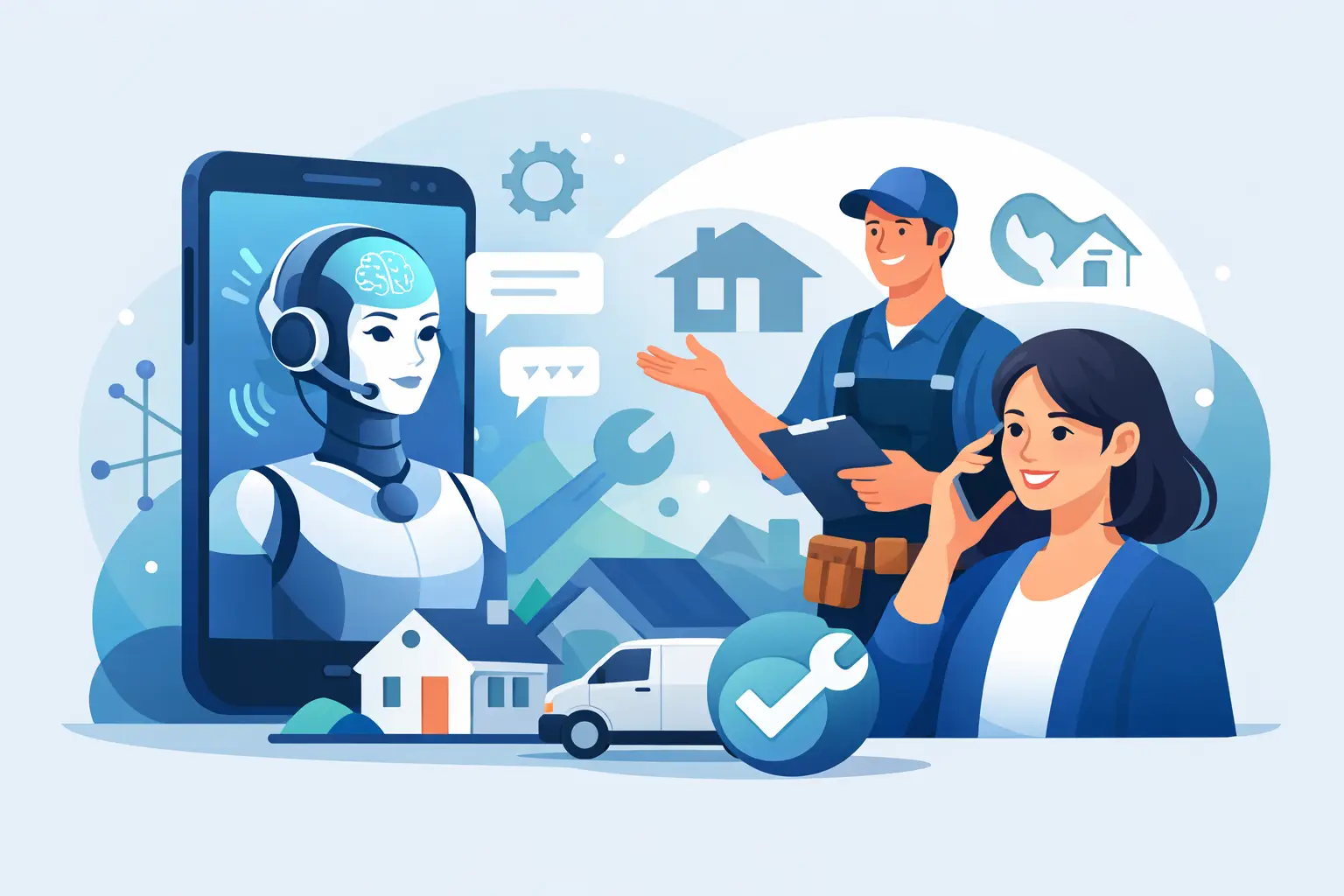
If your office misses three calls between 5:07 and 5:19 p.m., that is not just a scheduling issue. For a plumbing company, HVAC team, electrician, roofer, or cleaning business, those are booked jobs that likely went to the next company that answered first. An ai phone agent for home services fixes that revenue leak by answering instantly, qualifying the customer, and getting the job on the calendar even when your staff is busy, off-hours, or already on another line.
Home services runs on speed. The first company to answer, quote clearly, and lock in the appointment usually wins. That sounds simple until the phones spike during peak season, your dispatcher is juggling technicians, and every inbound call feels urgent. This is where voice automation starts paying for itself. Not as a novelty. As operating infrastructure.
What an AI phone agent for home services actually does
At a practical level, an AI voice agent handles the repetitive call work that slows down your front office. It answers inbound calls, asks the right questions, routes emergencies, books appointments, confirms service areas, and transfers to a human when needed. It can also place outbound calls for estimate follow-ups, appointment reminders, review requests, and unsold-job reactivation.
For home service operators, that matters because the phone is still the highest-intent channel. Website forms are useful, but a caller with a leaking pipe or a dead AC unit is ready now. If that call hits voicemail, the opportunity is already moving.
A strong setup does more than pick up. It follows your process. It knows whether you serve certain ZIP codes, how to handle after-hours emergencies, when to offer the next available slot, and when to escalate a call to live staff. If your business has multiple service lines, it can separate repair from install, warranty from new customer inquiries, and residential from commercial leads.
Why home service companies feel the ROI fast
The value shows up quickly because the pain is obvious. Missed calls cost revenue. Long hold times frustrate ready-to-buy customers. Manual reminder calls eat staff time. Dispatchers get buried in routine questions that do not require a person.
An AI phone system changes the math in a few ways. First, it gives you 24/7 coverage without building a night shift. Second, it handles multiple calls at once, which matters during storms, heat waves, cold snaps, or marketing campaigns. Third, it creates more consistency in intake. Every caller gets the same key questions, every time.
That consistency has downstream benefits. Better lead qualification means technicians are not driving out for bad-fit jobs. Better appointment capture means fewer gaps in the schedule. Better reminders and follow-ups can improve show rates and increase close rates on pending estimates.
This is especially useful for multi-location operators. If you run several territories, one centralized AI phone agent can answer across locations, route by geography, and standardize how calls are handled without turning every branch into its own call center.
Where an AI phone agent works best in home services
The best use cases are the ones that happen over and over and do not need judgment on every call. Booking routine service is the obvious one, but it is not the only one.
Inbound lead capture is usually the fastest win. The agent can greet the caller, identify the service needed, collect address details, confirm serviceability, and book or escalate. After-hours call handling is another major use case because home services demand does not stop when the office closes.
Outbound workflows are often overlooked. An AI agent can call back web leads within minutes, follow up on unsold estimates, remind customers about upcoming appointments, and reactivate past customers for tune-ups or seasonal maintenance. For operators trying to keep technicians fully booked, that kind of automation matters.
It also helps with overflow. If your internal team is strong during normal hours but gets swamped during spikes, AI can absorb the overflow rather than replacing the whole process. That is often the right move for companies that want tighter coverage without changing the customer experience too aggressively.
What separates a useful system from a frustrating one
Not every voice AI setup fits home services. A weak system sounds scripted, misses intent, and creates extra cleanup for your staff. The right one is built around operations.
Start with call handling depth. Can it answer inbound and run outbound? Can it book directly into your calendar or CRM? Can it qualify based on your real rules instead of generic prompts? If your dispatcher still has to re-enter everything by hand, the value drops fast.
Next is concurrency. Home service call patterns are uneven. You may have quiet periods, then sudden surges. A platform that can manage many calls at once is far more useful than one that behaves like a single virtual receptionist.
Knowledge matters too. If the agent can pull from your service FAQs, pricing ranges, policies, and location details, it becomes far more accurate. Website crawling and PDF ingestion can speed that setup, but guardrails still matter. You want the agent to stay within approved answers and transfer when confidence is low.
Reporting is another non-negotiable. You need recordings, transcripts, outcomes, and call analytics to improve scripts and measure return. If you cannot see what happened on the phone, you cannot manage performance.
And then there is the handoff. Some calls should go to a human. A good AI phone agent does not force automation into every corner. It knows when to transfer, when to flag urgency, and when to stay in its lane.
The trade-offs you should think through
Voice AI is not magic. It is a system, and the outcome depends on setup.
If your scheduling rules are messy, your service areas change constantly, or your pricing varies job by job, you need tighter configuration. That does not mean AI is a bad fit. It means you should automate the repeatable parts first and keep exceptions with your team.
There is also a customer experience question. Some homeowners are perfectly happy with an AI voice if it is fast and accurate. Others want a person right away, especially on sensitive or high-ticket jobs. The practical answer is not all or nothing. Many companies do best with a blended approach where AI handles intake, triage, and routine bookings, while humans take escalations, complex estimates, and upset customers.
The same goes for outbound calling. Automated follow-ups can lift conversion, but bad timing or poor scripting can feel pushy. The right strategy is targeted, useful, and tied to a clear operational goal.
How to deploy an AI phone agent for home services without slowing your team down
The fastest deployments start with one workflow, not ten. Pick the call type that creates the most friction today. For many companies, that is missed inbound calls after hours. For others, it is dispatch overload during business hours or slow follow-up on estimates.
Once that first workflow is stable, layer in calendar booking, CRM updates, reminders, and follow-up campaigns. Keep the script grounded in how your team already talks. Homeowners do not need futuristic language. They need quick answers, appointment options, and confidence that someone is handling the issue.
This is also where integration depth matters. If calls can flow into your CRM, calendar, and operating systems automatically, your team spends less time on admin and more time moving jobs forward. That is the difference between a phone bot and a real operations tool.
For companies that want speed, Cloud One-Ai fits this model well. It combines inbound and outbound calling, 300+ integrations, multilingual voice support, reporting, human handoff, and the ability to handle 50+ simultaneous calls. For home service businesses that need fast deployment and measurable call coverage, that all-in-one setup is easier to operationalize than stitching together separate tools.
What success looks like after launch
The first signal is simple. Fewer missed calls. After that, look at booked jobs, speed to lead, after-hours conversion, and how much front-office time is recovered. If you run outbound campaigns, track contact rates, appointments set, and reactivation revenue.
Do not expect every metric to improve on day one. There is usually some tuning involved. Maybe the script needs tighter qualification. Maybe transfers should happen earlier on certain call types. Maybe your reminders need a better cadence. The advantage of a modern platform is that you can actually see what is happening and improve from there.
For home services, the phone is too close to revenue to leave unmanaged. The companies that win more often are usually not doing something mysterious. They answer faster, follow up faster, and keep their calendar full without burning out the team behind it.
If that sounds less like innovation and more like operational discipline, that is exactly the point. The right AI phone agent should feel like another part of your infrastructure – always on, always working, and built to help you book the next job before it goes elsewhere.