



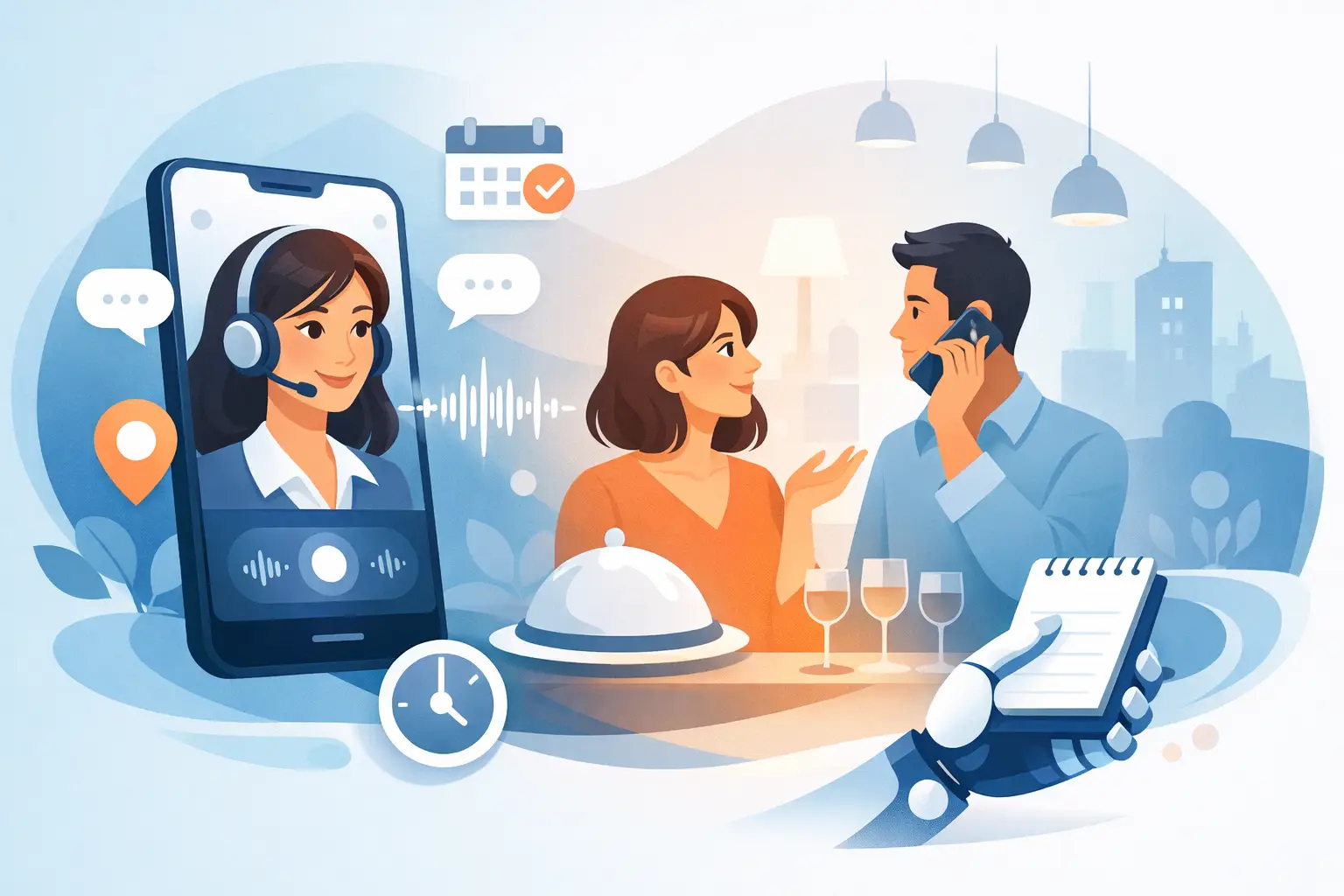
Friday at 6:17 p.m. is when a lot of restaurants lose revenue.
The host stand is packed. The phone is ringing. Staff are juggling walk-ins, table turns, takeout questions, and a server asking about a large party change. One missed call might be a lost four-top. Ten missed calls over a weekend can turn into a real hole in revenue.
That is where an ai voice agent for restaurant reservations stops being a nice idea and starts looking like operating infrastructure.
For restaurants that still rely heavily on phone bookings, the value is simple. Answer every call. Capture every reservation request. Confirm details accurately. Route edge cases to a person when needed. Do it after hours, during rushes, and across multiple locations without adding more labor to the schedule.
What an ai voice agent for restaurant reservations actually does
At a practical level, this is not just a chatbot with a phone number. It is a voice system built to handle live reservation calls the way a trained front-of-house employee would handle them.
A caller says they need a table for four at 7:30. The agent checks availability, confirms the date and party size, collects the guest name and phone number, and books the reservation in the restaurant’s calendar or reservation workflow. If the requested slot is full, it can offer alternatives. If the caller wants to ask about patio seating, corkage, private dining, or whether high chairs are available, the agent can answer based on the restaurant’s approved knowledge base.
That matters because reservation calls are rarely just one question. They often include special requests, policy questions, timing changes, or accessibility needs. A useful voice agent has to do more than transcribe speech. It has to guide the conversation toward an outcome.
Why restaurants are adopting voice AI now
Most restaurants do not have a technology problem. They have a coverage problem.
Calls come in when staff are busiest. Phones ring before opening, after closing, and during shift transitions. Multi-location groups have an even harder version of this problem because standards vary by site, and call handling depends too much on whoever happens to be near the phone.
An AI voice agent solves the coverage gap first. It gives the restaurant an always-on reservation layer that does not get distracted during service and does not stop working when labor is tight. That can improve booking capture immediately.
The second reason is cost control. Hiring more staff just to answer phones is expensive, especially when reservation demand spikes at predictable windows rather than staying steady all day. Voice automation lets operators cover peak call volume without staffing for the absolute busiest 30 minutes of the week.
The third reason is consistency. A good reservation experience should not depend on which employee answers. Policies on late arrivals, cancellation windows, large parties, and seating preferences should be handled the same way every time.
The business case is bigger than booking tables
A restaurant reservation call is often the first conversion event. It is also a customer service moment.
When the phone is unanswered, guests do not think, “They must be busy.” They think, “I’ll try the next place.” That is especially true for casual dining, local favorites, and high-intent diners calling the same day.
An ai voice agent for restaurant reservations helps in three direct ways. It captures calls that would otherwise be missed, shortens hold times, and reduces the back-and-forth that causes booking friction. Those gains show up in covers, labor efficiency, and guest experience.
There is also a follow-through benefit. Once reservations are captured in a structured way, restaurants can automate confirmations, reminders, and updates. That can reduce no-shows and make it easier to manage demand around peak hours.
For multi-location operators, reporting becomes just as important as call handling. You can see call volume by location, track missed opportunities, review transcripts, and understand what guests are asking before managers have to guess.
Where voice AI works well, and where it needs guardrails
Reservation calls are one of the stronger fits for voice automation because the workflow is structured. Date, time, party size, contact details, special requests, and confirmation are straightforward.
But restaurants should not treat every call as identical. There are edge cases where human handoff matters.
A private event inquiry, a VIP complaint, a same-night request for a party of 18, or a guest with a complex allergy question may need a manager or host. The right setup is not “AI only.” It is AI first, with a clear path to transfer when the request falls outside policy or confidence thresholds.
That trade-off matters. Full automation sounds efficient, but over-automating sensitive conversations can hurt the guest experience. The better approach is controlled automation. Let the agent handle repetitive, high-volume reservation traffic and escalate the exceptions.
What to look for in a restaurant reservation voice agent
If you are evaluating options, the core question is not whether the agent can talk. It is whether it can operate inside your real reservation process.
It should connect with calendars, CRMs, or operational systems so bookings do not live in a separate silo. It should support custom call flows for things like large party routing, holiday hours, waitlist logic, and location-specific policies. It should also support multilingual calls if your customer base demands it.
Reliability matters more than novelty. During dinner rush, the system has to answer quickly, handle multiple calls at once, and log every conversation. Reporting is not a nice extra either. Recordings, transcripts, disposition data, and call analytics give operators the visibility they need to improve scripts and staffing decisions.
This is also where platforms differ. Some tools offer a narrow single-use bot. Others operate more like a full AI call center that supports inbound and outbound calls, integrations, human transfers, and knowledge base control from one system. For operators planning to automate more than reservations, that distinction matters.
Implementation is less about AI and more about operations
Restaurants usually get the best results when they treat deployment like a front-of-house process project.
Start with the booking rules. What time slots are available? How should the agent handle overbook risk? What counts as a large party? Which questions can it answer directly, and which should trigger transfer or callback? If the restaurant has multiple locations, define what is standardized and what is local.
Then train the knowledge base using approved sources such as menus, policy documents, event details, FAQs, and website content. This keeps answers grounded in what the business actually wants said.
Finally, test with real scenarios. Busy-night reservation requests. Same-day changes. Callers with accents. Callers asking two things at once. The goal is not to make the agent sound clever. The goal is to make it accurate, fast, and dependable.
That is why platforms built for business telephony have an edge. Cloud One-Ai, for example, is positioned as an operations-ready voice layer, not a novelty feature. It combines live calling, workflow automation, reporting, knowledge ingestion, and human handoff in one system, which is what restaurants actually need when phone volume affects revenue.
Multi-location restaurants have the most to gain
Independent restaurants can benefit quickly from better call coverage, but multi-location groups often see the bigger operational upside.
A centralized voice setup can answer for several stores, apply brand-level policies, and route location-specific calls correctly. That reduces inconsistency between sites and gives leadership one place to monitor performance.
It also helps with staffing volatility. If one location is short on hosts or managers, the reservation line does not collapse. The agent keeps booking, answering common questions, and escalating only the calls that require store-level attention.
For franchise groups and restaurant agencies, there is another angle. White-labeled voice AI can become a service offering, especially for operators that want a faster path to deployment without stitching together telephony, automation, and analytics tools on their own.
The real question: should every restaurant use it?
Not every concept needs the same level of automation.
If a restaurant gets very few phone reservations and most demand comes through walk-ins or third-party booking channels, the impact may be modest. If the menu, hours, and policies change constantly without clear documentation, setup will take more discipline. And if the brand is built around highly personal concierge-style booking, human-led service may still need to stay front and center.
But for restaurants that miss calls, struggle with peak-hour coverage, manage multiple locations, or want to reduce labor tied to repetitive phone work, voice AI is a strong fit. The economics are usually easy to understand because the baseline problem is visible. Missed calls cost money. Slow response costs bookings. Inconsistent call handling creates avoidable friction.
Restaurants do not need more experimental tech. They need systems that answer the phone, book the table, and keep service moving when the floor gets busy. That is why the best time to evaluate voice AI is not when you want to sound innovative. It is when you are tired of hearing a ringing phone and knowing revenue is slipping away.