



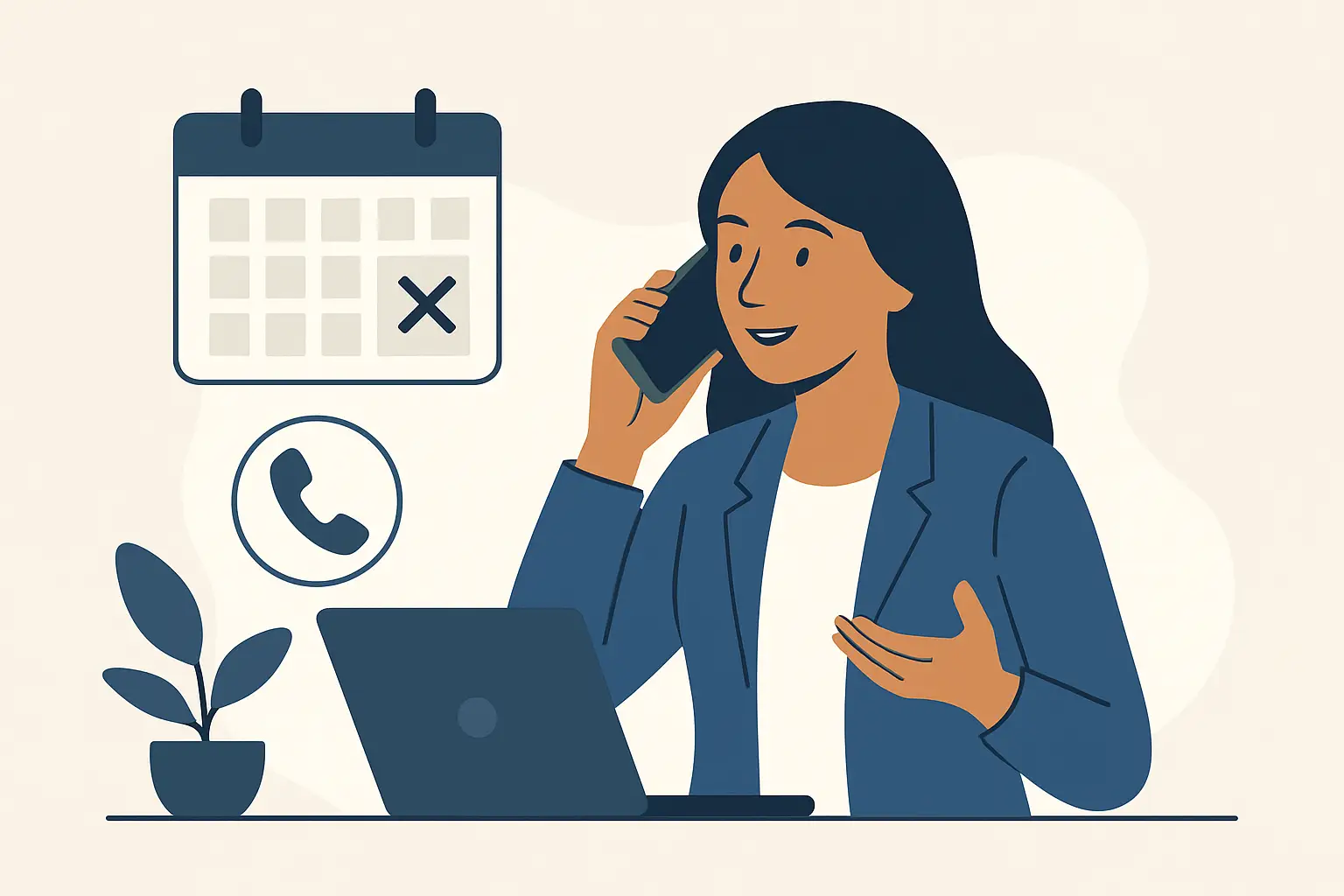
A patient no-shows at 10:00 a.m. Your front desk is already juggling check-ins, insurance questions, and the next caller who wants “the first available.” By the time someone circles back to that missed appointment, it’s 4:30 p.m., the day is basically over, and the rebook window has cooled off.
That gap – the hours between the miss and the outreach – is where revenue leaks. It’s also where most teams get stuck, because follow-ups are repetitive, time-sensitive, and hard to do consistently at scale.
Automated follow up calls after missed appointment solve a simple operational problem: the best time to recover a no-show is right after it happens, not when someone finally has a free moment.
Why missed-appointment follow-up breaks in real life
No one skips follow-ups because they don’t care. It breaks because the workflow competes with higher-friction tasks that feel more urgent.
A missed appointment triggers a chain reaction: schedule gaps, staff idle time, unused rooms, a doctor running behind later to “catch up,” or a service bay sitting empty. But the outbound call to rebook is rarely the top priority in the moment.
There’s also a human factor. Staff hesitate because they don’t want to sound accusatory. They don’t know what to say. Or they tried once, got voicemail, and moved on.
A good follow-up process has three properties: it’s fast, it’s consistent, and it’s measurable. Manual calling struggles with all three.
What “automated follow up calls” actually means
This isn’t a robocall blasting a generic message.
Modern Voice AI can place a natural-sounding call, confirm the reason for the miss, offer rescheduling options, and book directly into your calendar. It can also send an SMS fallback when the call goes unanswered, and route to a human when the situation is sensitive.
The best implementations feel like a reliable ops layer. The system runs the moment a no-show is logged, and every outcome gets written back to the tools you already use.
The outcomes that matter: show rate, speed, and recovered capacity
Most businesses think about missed appointments as a “patient problem” or “customer problem.” Operationally, it’s a throughput problem.
When you deploy automated follow up calls after missed appointment, you typically see three wins:
First, faster rebooking. When outreach happens within minutes, you catch people before they get into the rest of their day or book elsewhere.
Second, fewer dead slots. Even if you can’t rebook the same day, you can fill future capacity that would have been lost to inertia.
Third, cleaner data. You stop guessing why people no-show. You’ll have categorized reasons and call outcomes you can report on by location, provider, service type, and time of day.
None of this is magic. It’s just consistent execution, done at the speed your schedule requires.
Timing rules that move the needle
If you only change one thing, change how quickly you call.
For most appointment-based businesses, the best initial attempt is 5-15 minutes after the scheduled time passes and the appointment is marked missed. That window is early enough to be relevant but late enough that you’re not calling someone who is parking or walking in.
After that, you want a short sequence that respects attention and avoids spam behavior. A practical pattern is a second attempt later the same day and one more the next day, with SMS or email support in between.
It depends on your industry. Healthcare and dental often benefit from slightly more persistence because rescheduling has real health consequences. Salons and personal services tend to need a lighter touch to preserve goodwill. Restaurants handling reservations may want a same-day recovery attempt only, because tomorrow’s rebook isn’t the same product.
Script strategy: firm, polite, and outcome-focused
A missed-appointment call should do one job: get to a next step. Apologies and explanations matter, but only if they move the schedule.
Your script should sound like a calm operations professional, not a debt collector and not a friend who’s “just checking in.”
A strong flow usually includes: confirming identity, stating the missed appointment plainly, offering a simple reason prompt, then immediately presenting options. “Would you like the soonest available, or do you prefer later this week?” works because it assumes a rebook and reduces decision fatigue.
Where teams go wrong is asking open-ended questions that invite a long story when the real goal is a booked slot. Voice AI can still be empathetic, but it should steer toward scheduling.
You also want clean handling for the common edge cases: patient is sick, car trouble, forgot, no longer needs service, wants a different provider, needs to check with spouse, wants pricing first, or is upset about wait time.
When you should not automate the entire call
Automation is powerful, but not every missed appointment should be fully self-serve.
If the account is high-value, the situation is emotionally charged, or the customer mentions a medical complication or legal urgency, you want a fast handoff to a person. The goal is not to win an argument with a bot. The goal is to preserve the relationship and still protect the schedule.
A good system uses guardrails: if specific phrases are detected or if the caller requests a human, transfer immediately. You keep the speed advantage without forcing automation where it doesn’t fit.
The operational setup that makes this work (without new headaches)
The difference between a “cool demo” and a workflow your team trusts is integration.
At minimum, you need the automation to read and write four things correctly: appointment status, contact details, calendar availability, and follow-up outcomes.
That usually means connecting your CRM or practice management system, your calendar, and your messaging tools. When a no-show is marked, the call launches. When the customer rebooks, the new appointment is written back. When the call hits voicemail, the outcome is logged and the next attempt is scheduled.
This matters for multi-location operators. If you have five clinics or twenty storefronts, consistency is the product. Automation ensures Location 12 follows the same rules as Location 1, and reporting lets you see which sites have the biggest no-show recovery opportunity.
Compliance and consent: keep it business-ready
Missed-appointment outreach touches regulated territory in some industries.
Healthcare teams need to be careful about what is said on voicemail and how identity is confirmed. Other businesses need to pay attention to calling hours, opt-outs, and internal do-not-call preferences.
Automation helps here when it’s configured correctly. You can control exactly what the agent is allowed to say, what it avoids, and how it handles voicemail. You can also enforce time windows and suppression lists so the system doesn’t call outside your rules.
The trade-off is that you have to do the upfront work. If you “set and forget” without reviewing scripts and edge cases, you’ll create friction fast. The best approach is to launch with a conservative script, monitor recordings and transcripts, then iterate.
What to measure (and what not to obsess over)
If you want this to be more than a shiny tool, pick metrics that map to capacity and revenue.
Recovery rate is the headline: of missed appointments, how many rebook within 7 days? Also track time-to-first-contact, because speed is the lever you control.
You should also watch disposition breakdowns. If “couldn’t reach” is high, you may need better caller ID, different timing, or SMS support. If “no longer interested” spikes, that’s not a calling problem – that’s an experience problem upstream.
Don’t get stuck chasing perfect call length or trying to eliminate every voicemail. You’re building a dependable system, not an art project.
Where Cloud One-Ai fits
If you want automated follow up calls after missed appointment to run like infrastructure – fast deployment, multilingual coverage, and outcomes written back to your CRM and calendars – Cloud One-Ai is built for that ops-first model, with parallel calling, reporting, knowledgebase control, and human handoff when it matters.
A closing thought for operators
No-shows will never hit zero. Life happens, phones die, kids get sick, traffic wins.
The operational advantage is not pretending you can prevent every miss. It’s building a response that triggers instantly, speaks clearly, protects your brand, and turns “lost” into “rebooked” before the day gets away from you.