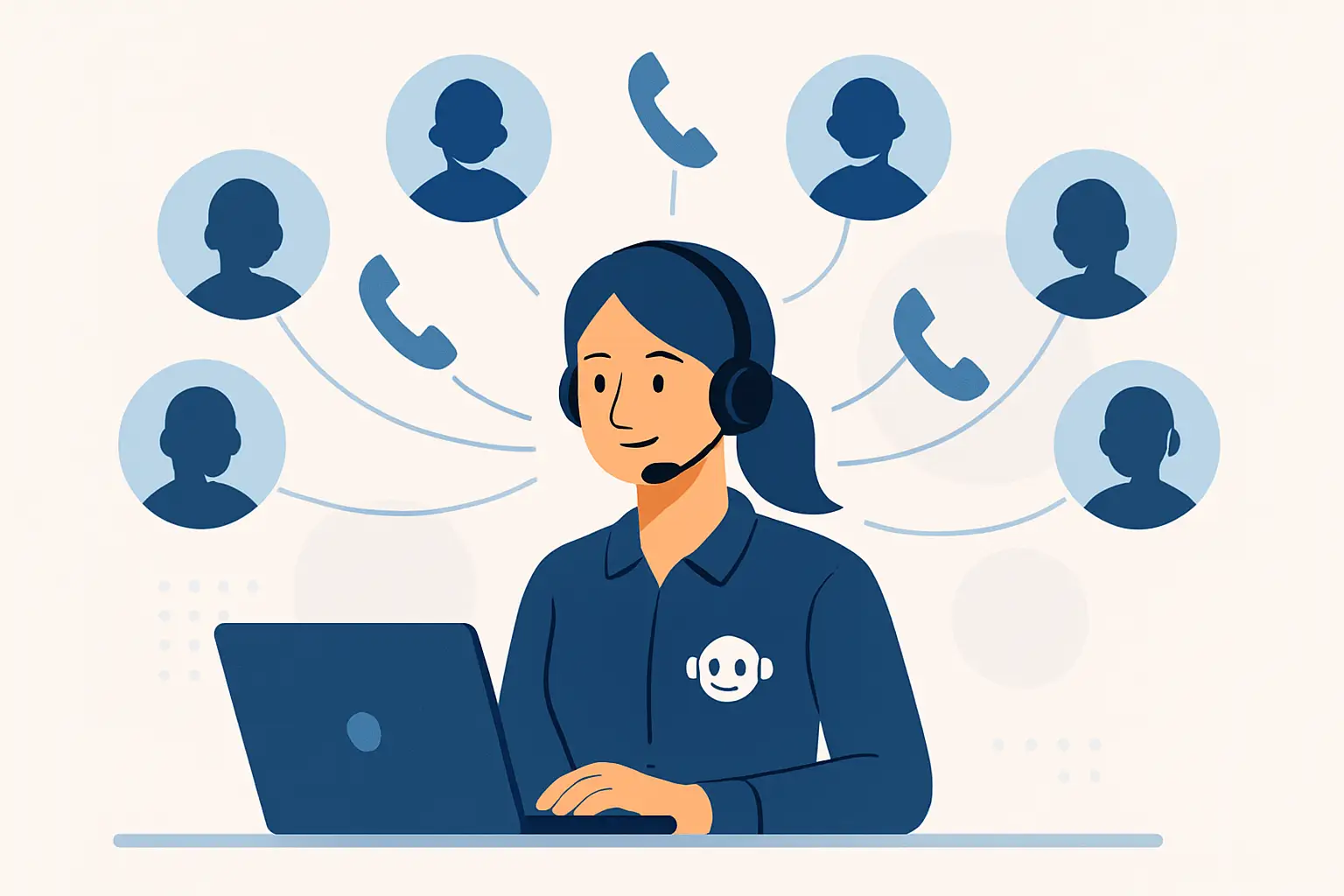
Your front desk is doing two jobs at once: answering the phone and preventing revenue leaks.The leak is usually the same. A caller hits voicemail, waits on hold, or gets rushed because the team is juggling a line out the door. The fix is not “hire more people” by default. The fix is capacity – specifically, the ability to handle multiple conversations at the same time without quality dropping.That is the real promise behind a simultaneous calls ai voice agent: parallel conversations that still feel like a competent, calm operator. Not a phone tree. Not a chatbot. An agent that can answer, qualify, book, and follow up – at the exact moment demand spikes.
What “simultaneous calls” actually means
Simultaneous calls is not the same as “high call volume.” Volume is how many calls happen in a day. Simultaneous is how many are happening right now.That distinction matters because most missed-call problems are concurrency problems. A dental office can have only 120 calls a day and still miss 25% of them if 20 of those calls hit between 8:00 and 8:30 AM. A restaurant can have a manageable daily total but get slammed for 45 minutes around lunch.A simultaneous calls AI voice agent is designed for that exact moment. It picks up on the first ring, handles overlapping conversations, and routes outcomes into your systems (calendar, CRM, ticketing) as each call ends.There is also a second meaning that operators care about: how many lines you can run for outbound. If you are dialing leads, renewals, confirmations, or collections, parallelism determines throughput. One agent making one call at a time is a nice demo. Ten or fifty simultaneous calls is an operational lever.
The business case: speed-to-answer beats “perfect scripts”
Most teams obsess over what the agent will say. That matters, but the bigger win is being available.When someone calls, they are already indicating intent. If you answer immediately, you control the next step: book the appointment, capture the lead, take the order, or resolve the issue. If you do not answer, you hand control back to the customer. They call a competitor, they abandon, or they show up annoyed.Parallel call handling is how you buy back response time. It eliminates the queue. It prevents the “we’ll call you back” pile-up that quietly destroys show rates.The trade-off is that you have to treat voice like infrastructure. Capacity planning, routing rules, and reporting become part of operations – not an afterthought.
Where parallel calling creates immediate ROI
A simultaneous calls ai voice agent pays off fastest in workflows where the outcome is binary and time-sensitive: booked or not booked, qualified or not qualified, confirmed or not confirmed.
Appointment-heavy businesses
Clinics, dental groups, salons, and multi-location service operators win because the phone is the booking engine. Peak times are predictable (open, lunch, close), and a single missed call can turn into a lost high-LTV patient.With parallel handling, callers do not stack into a hold queue. Each caller can get availability, book, reschedule, ask basic prep questions, and receive confirmation in one interaction.
Sales and lead qualification
For inbound leads, speed matters. For outbound, throughput matters.On inbound, the agent can ask a few qualification questions, confirm location and budget range, and schedule the rep. On outbound, parallel dialing can run campaigns that would normally require a team of SDRs – while still capturing detailed outcomes per call.The key is controlling the handoff. Not every lead should go to a human. Only the ones that match your criteria and are ready now.
Customer support and after-hours coverage
Support calls spike when things go wrong. That is also when humans get overwhelmed.Parallel voice agents handle repetitive requests (hours, policies, order status, basic troubleshooting) and escalate when the caller is frustrated, the case is complex, or compliance requires a person. 24/7 coverage is less about being “always on” as a slogan and more about removing the dead zone where callers give up.
What you need for 10, 20, or 50+ simultaneous calls
Concurrency is not just a number on a pricing page. It is the combination of telephony, model performance, routing logic, and back-end integrations.
1) Telephony that is built for scale
If your calling stack was designed for a handful of lines, it will crack under peak demand. You need stable carrier-grade connectivity, the ability to provision numbers across regions, and consistent call quality when many lines are active.
2) A conversation engine that does not collapse under load
Handling many calls at once is not only about “can it pick up.” It is also about maintaining natural pacing, remembering context within each call, and recovering gracefully from interruptions.Poor implementations sound fine in a quiet test and fall apart at scale: delays, awkward over-talking, or missed intent. At 20+ concurrent calls, those small issues become a brand problem.
3) A knowledge source the agent can trust
The more calls you run in parallel, the more you need consistent answers.If the agent is pulling from a controlled knowledgebase (documents, FAQs, policies, and approved pages), you reduce hallucinations and prevent the “it told me something different yesterday” complaint. This is also where governance matters: defining what the agent is allowed to answer and when it must escalate.
4) Integrations that close the loop
If the call ends and the data dies in a transcript, you did not automate the operation.You want each call to create the next step automatically: a calendar booking, a CRM update, a ticket, a follow-up text, a tag for the pipeline, or an outcome field your team can filter. Without that, higher concurrency just creates more work.
5) Reporting that makes scaling safe
Parallel calling increases activity. Reporting keeps it controlled.Recordings and transcriptions help with QA. Outcome charts show where callers drop. Agent-level metrics show where scripts need tightening. Most importantly, concurrency forces you to manage exceptions: wrong bookings, unclear intents, edge-case policy questions. You need visibility before those exceptions become noise.
Capacity planning: how many simultaneous calls do you actually need?
Most businesses guess. Better is to size it like an ops leader.Start with your peak hour. Look at your busiest 15-minute block on a typical weekday. If you get 24 calls in that block and the average call lasts 3 minutes, that is 72 call-minutes of demand in 15 minutes.Divide demand by time window: 72 call-minutes / 15 minutes = 4.8 concurrent calls.So a five-line concurrent capacity covers that peak – with no buffer. If you want breathing room for longer calls, transfers, or a sudden spike, you size up.For outbound, it is simpler. Decide how many dials per hour you want, estimate average connected-call length, and set concurrency to hit the throughput. Then throttle based on answer rates and agent outcomes. More parallel calls is not always better if your list quality is weak or your downstream team cannot handle the booked appointments.“It depends” is real here. A legal office might need fewer simultaneous calls but longer, higher-stakes conversations and stricter escalation rules. A multi-location home services operator may need higher concurrency because calls are shorter and more transactional.
Common failure points (and how to avoid them)
Parallel calling amplifies what is already true about your operation.If your intake process is vague, the agent will capture vague data faster. If your calendar rules are messy, the agent will book into the mess more efficiently. The goal is not automation for its own sake. The goal is clean outcomes at speed.The most common pitfalls are:
Over-automating edge cases. If a caller has a complex insurance question or a high-emotion complaint, escalation should be easy and fast.
Under-specifying booking rules. Define service types, appointment lengths, buffers, and location routing before you scale.
Treating scripts as static. High-performing voice ops adjust weekly based on transcripts and conversion drop-offs.
Forgetting downstream capacity. If the agent books 30% more appointments, can your team fulfill them? If not, build throttles and prioritization.
What to look for in a platform built for simultaneous calls
If simultaneous calls is a core requirement, you want a platform that was designed as an AI call center, not a bolt-on voice widget.Look for built-in inbound and outbound support, parallel call handling at meaningful levels (not two or three), fast agent setup, multilingual coverage if you serve diverse markets, and no-code integrations that push call outcomes into your existing stack.If you are an agency or consultant, also look at whether you can run multiple client subaccounts, control branding, and rebill cleanly. Voice AI is sticky when it is tied to operations, and white labeling turns that stickiness into recurring revenue instead of one-off projects.One example is [Cloud One-Ai](https://cloudone-ai.com), which is built specifically for inbound and outbound AI calling with 50+ parallel calls, multilingual agents, knowledgebase ingestion, reporting, integrations, and human handoff – packaged as a deployable platform rather than a custom build.
The real shift: phones stop being a bottleneck
When you can answer every call immediately and handle spikes without scrambling, the phone becomes what it should have been all along: a predictable input channel.That predictability changes how you run the business. You can launch campaigns without worrying about the front desk. You can expand hours without staffing a graveyard shift. You can measure performance by outcomes instead of anecdotes.The helpful mindset is simple: do not buy “AI.” Buy response time, throughput, and clean handoffs. If a simultaneous calls ai voice agent gives you those three, you will feel it in bookings, revenue, and calmer days – especially during the hours you used to dread.